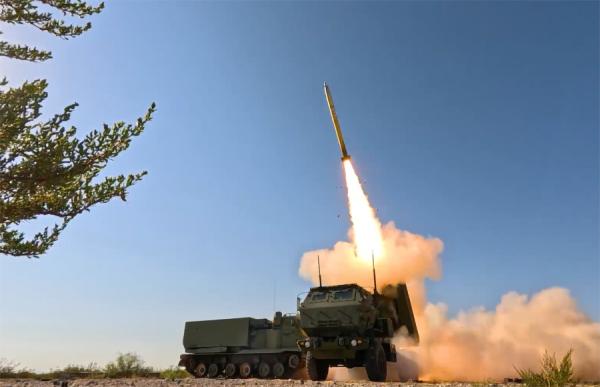
Lockheed Martin has redirected a Guided Multiple Launch Rocket System (GMLRS) rocket mid-flight for the first time in the programme’s history, according to the company. The test, run with the U.S. Army at White Sands Missile Range, ended with the rocket destroying a moving target.
How the test worked
The team fired the GMLRS from a High Mobility Artillery Rocket System (HIMARS) launcher. Engineers then used the Strigo datalink and the Remote Interceptor Guidance-360 (RIG-360) to change the rocket’s target while it was airborne. Lockheed Martin integrated both systems with its own internal funding.
Why it matters
The demonstration expands what the combat-proven GMLRS can do without altering the missile itself. It connects sensors, launchers and targeting systems that the Army already fields.
Commanders gain a way to adjust strikes that were pre-programmed before launch. If battlefield conditions change, they can now retarget the rocket rather than accept a fixed firing solution.
Networked fires
The live-fire event supports the Army’s vision of networked precision fires. That concept links sensors, launchers and targeting systems into a single kill chain and gives soldiers more flexibility against dynamic threats.
Wider application
Lockheed Martin says the datalink package applies to other precision fires weapons. These include Extended Range GMLRS and the Precision Strike Missile (PrSM). Fitting it across those munitions would extend networked fire across a broader range of the Army’s long-range arsenal.
Learn more on Lockheed Martin’s website