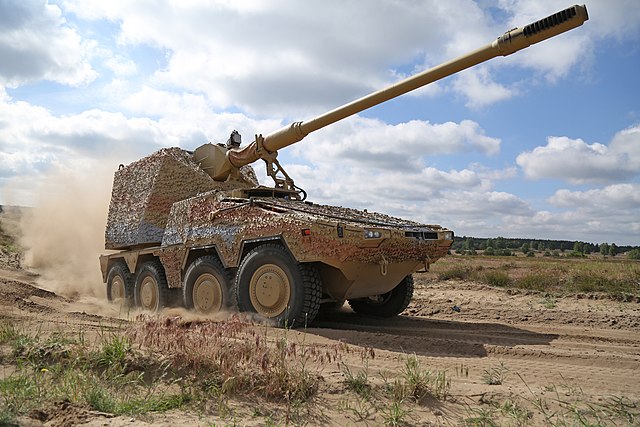
Image: KNDS via Wikimedia Commons
The United Kingdom and Germany have signed a £52 million contract to acquire a new generation of mobile artillery able to fire while manoeuvring and strike targets up to 70 kilometres away.
The agreement delivers an Early Capability Demonstrator (ECD) version of the RCH 155 to the British Army, with two additional systems assigned to Germany for joint testing, according to the UK Ministry of Defence.
The deal marks a significant milestone in bilateral defence cooperation under the Trinity House agreement, signed in October 2024. That framework commits London and Berlin to deeper military collaboration across procurement, testing, and operational integration.
Addressing the British Army’s Mobile Fires Requirement
The RCH 155 will serve as the long-term solution for the British Army’s Mobile Fires Platform programme. It will ultimately replace interim systems now in service.
British forces currently operate 14 Archer self-propelled howitzers. The UK acquired those systems as a temporary measure after donating its AS90 artillery fleet to Ukraine.
Mounted on the Boxer armoured vehicle, the RCH 155 combines high mobility with automated firepower. The system can fire up to eight rounds per minute while travelling at speeds approaching 100 kilometres per hour.
It can engage targets in any direction without repositioning and travel roughly 700 kilometres without refuelling. Advanced automation allows operation by a two-person crew.
Unlike conventional artillery, the RCH 155 does not need to halt and deploy before firing. That capability reduces vulnerability to counter-battery fire and supports rapid “shoot-and-scoot” tactics.
Lessons from Ukraine Shape Procurement
UK defence officials say operational lessons from Ukraine directly influenced the acquisition.
“The British Army will soon have new artillery that can fire on the move,” said Defence Readiness and Industry Minister Luke Pollard MP, according to the Ministry of Defence. He highlighted the system’s ability to strike at long range and rapidly relocate.
Pollard said the war in Ukraine underscored the importance of rapid fires and mobility. Those lessons now inform UK procurement decisions and the ongoing Strategic Defence Review.
Western militaries have closely studied the conflict, where artillery survivability depends on speed, dispersion, and digital targeting rather than static fire positions.
Joint Testing to Reduce Costs and Risk
Under the contract, the UK and Germany will share test facilities, trial data, and evaluation results. Officials say the approach will shorten timelines while reducing overall programme costs.
Edward Cutts, the British Army’s Senior Responsible Owner for Mobile Fires, described the demonstrator programme as a practical example of the Trinity House agreement in action.
By working jointly, he said, both nations can deliver advanced artillery capabilities more efficiently than through separate national programmes, according to the Ministry of Defence.
The arrangement also supports closer technical alignment between the two armies. That interoperability remains a priority within NATO, particularly for high-intensity land warfare.
Industrial and Strategic Significance
UK officials say the agreement supports domestic defence industry objectives. The contract aligns with the Strategic Defence Review’s goal of using defence procurement to sustain skilled employment and industrial capacity.
Beyond industry benefits, the deal reinforces military ties between London and Berlin at a time of growing security pressure across Europe.
As NATO focuses on deterrence and rapid reinforcement, mobile artillery systems such as the RCH 155 play a central role in supporting armoured formations and countering peer adversaries.
The joint programme signals a broader shift toward collaborative procurement among European allies, driven by operational urgency and budget constraints.
Source: UK DE&S Press Release