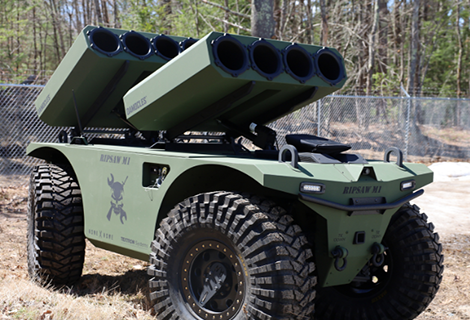
New UGV technology demonstrator targets littoral warfare and autonomous teaming missions
Image: Textron Systems
Textron Systems and its subsidiary Howe & Howe have unveiled the RIPSAW M1, an uncrewed ground vehicle (UGV) technology demonstrator aimed at supporting U.S. Marine Corps combat operations, according to a Textron Systems press release.
A Scalable Platform for Future Marine Operations
The M1 is the latest in Textron’s family of Modular Open Systems Approach (MOSA)-designed UGVs. It represents the first variant in the new M1 line and is built to pair with the Marine Corps’ Advanced Reconnaissance Vehicle (ARV) and Amphibious Combat Vehicle (ACV). Both platforms sit at the centre of Force Design 2030, the Corps’ ongoing effort to restructure for high-end naval and littoral warfare.
Designers built the M1 as a robotic force multiplier. The vehicle can execute hard-kill counter-unmanned aircraft system (UAS) missions, conduct reconnaissance, surveillance and target acquisition (RSTA), and serve as a loitering munition launch platform. The intent is to extend Marines’ reach and lethality while keeping personnel away from direct threat exposure.
Industry Comment
Sara Willett, Vice President of Programs at Textron Systems, said the demonstrator shows what UGVs can achieve in Marine Corps mission sets.
“Along with Howe & Howe, we took our experience in autonomous robotic systems across land, air and sea — the same domains the Marine Corps’ missions live — to develop this system,” Willett said. The company says SWAP (size, weight and power) can scale up or down while retaining a common robotic core.
Why It Matters
The Marine Corps’ Force Design 2030 restructured the service around distributed maritime operations across the Pacific. That shift created demand for lighter, more autonomous systems that can project force without large, vulnerable formations. UGVs like the M1 fit directly into that doctrine.
Counter-UAS capability has become a pressing priority across all U.S. services. Drone threats exposed during conflicts in Ukraine and the Middle East accelerated demand for ground-based systems able to detect and defeat aerial threats at the unit level. Mounting that capability on an uncrewed platform reduces crew risk significantly.
The loitering munition launch function adds further tactical value. A small, mobile UGV operating forward of crewed vehicles provides commanders with an organic precision strike option without risking personnel.
Howe & Howe and Textron’s UGV Pedigree
Howe & Howe brings an established track record to the programme. The company developed the RIPSAW M5, a high-speed tracked UGV previously demonstrated for the U.S. Army, and the Thermite robotic firefighter. Textron Systems claims millions of operational hours across uncrewed air, surface, and land platforms.
That depth of experience matters in defence procurement, where demonstrated reliability often outweighs paper specifications. Textron is positioning the M1 demonstrator as proof it can deliver scalable autonomous ground systems at programme speed.
Next Steps
The M1 remains a technology demonstrator. No procurement contract or programme of record has been announced. Its public debut places it directly before Marine Corps acquisition officials and warfighters at a key requirements-shaping event.
Whether the Corps moves toward a formal programme will depend on how well the M1 fits evolving CONOPS requirements — and on competing proposals from other UGV developers working the same market.
Source: Textron Systems press release