Image: Australian MoD
The Royal Australian Air Force and Royal New Zealand Air Force have wrapped up a five-week combined exercise at RAAF Base Richmond in New South Wales, reinforcing one of the Indo-Pacific’s closest bilateral defence partnerships.
Exercise Trojan Compass ran from February 2 to March 5, bringing together RNZAF’s 40 Squadron and RAAF’s 37 Squadron. Personnel operated side by side across airlift missions, maintenance, logistics, and support functions — embedding New Zealand airmen directly into Australian unit structures.
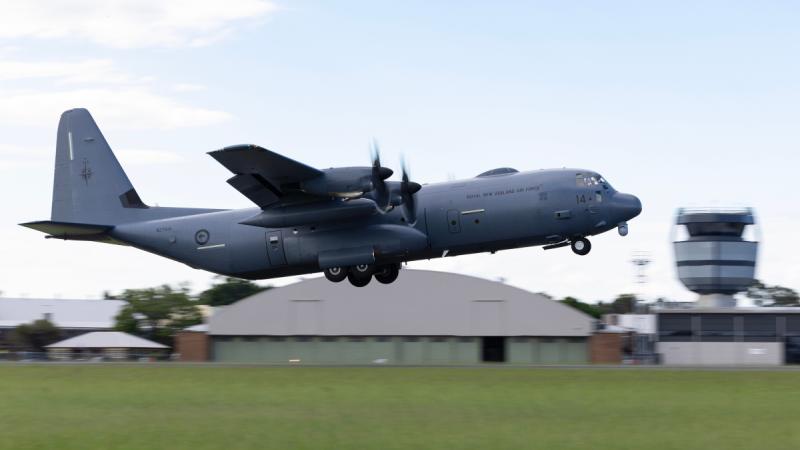
A significant milestone came when the RNZAF deployed its C-130J Hercules internationally under an Australian national call sign to complete Australian Defence Force tasking. Squadron Leader Adam Palmer, the New Zealand Detachment Commander, described it as a key highlight of the exercise. “A key highlight was deploying the New Zealand C-130J internationally under an Australian national call sign to complete international tasking for the Australian Defence Force,” he said, according to the RAAF.
Both air arms fly the C-130J, and that common platform proved a powerful enabler throughout the exercise. New Zealand Logistics Officer Flight Lieutenant Kelsey May worked alongside Australian counterpart Flight Lieutenant Riley Kennedy for the duration. “We have similar machinery and similar aircraft — it makes it easy for us to prepare freight and load, as we have the same processes and procedures,” May said.
Kennedy pointed to interoperability as the defining outcome. “Working with a foreign nation has been excellent and we have learnt a lot from each other along the way,” she said.
Beyond shared procedures, the exercise built something harder to quantify: professional trust. Working from the same flight lines and hangars each day, personnel from both forces exchanged best practices and learned how their counterparts operate in a real-world environment. That human dimension matters — coalitions under pressure rely on relationships built long before a crisis erupts.
Squadron Leader Palmer framed the exercise in terms of regional readiness. “Deploying on Exercise Trojan Compass allowed us to practise our skills so if we need them in the wider region or around the globe, we are ready to respond as required,” he said.
The Australia–New Zealand defence relationship sits within the Five Eyes intelligence framework and the ANZUS Treaty. Both nations face growing demand signals across the Indo-Pacific, from humanitarian response to potential high-end operations. Exercises like Trojan Compass serve a direct strategic function — cutting friction at the critical early stages of any joint deployment.
The ability to operate under each other’s call signs, share logistics chains, and embed personnel within allied units is exactly what that demands.
You can read more about Exercise Trojan Compass on the Australian MoD Website