Image: Rheinmetall
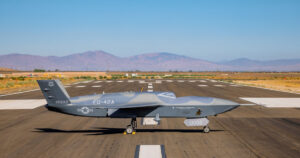
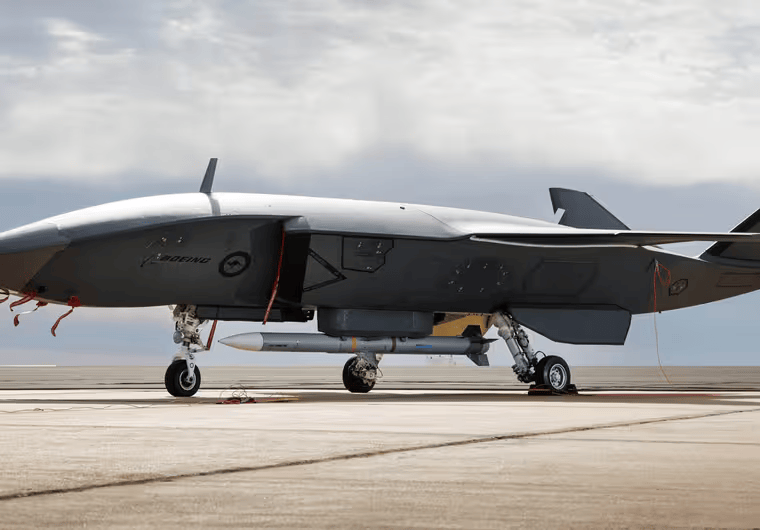
Rheinmetall and Boeing Defence Australia have announced a strategic partnership to deliver the MQ-28 Ghost Bat autonomous combat aircraft to Germany’s Bundeswehr, targeting an operational capability date of 2029.
The two companies are pitching the Ghost Bat as a mature, ready-to-integrate solution for Germany’s collaborative combat aircraft (CCA) requirement. Under the deal, Rheinmetall will act as system manager for the MQ-28 in Germany, overseeing integration into Bundeswehr command and weapons systems, national adaptation, and full operational and logistical support.
Boeing’s MQ-28 has completed more than 150 flights since development began in Australia eight years ago. Designed initially for the Royal Australian Air Force and partner nations, the aircraft operates as a force multiplier — teaming with manned platforms to generate combat mass in contested airspace. Its modular architecture supports reconnaissance, electronic warfare, and weapons integration missions.
Most recently, the platform demonstrated a significant autonomous capability milestone, successfully engaging and destroying an airborne target in a first-of-its-kind live trial.
Rheinmetall CEO Armin Papperger said the partnership would create a dedicated industrial hub in Germany and Europe. “As a system integrator, we ensure that integration, operation, and further development come from a single source,” he said, according to the joint announcement. Papperger put Rheinmetall’s revenue potential from the programme in the “three-digit millions of euros” range.
The agreement includes a dedicated in-country digital environment where German and Australian engineers will jointly develop, test, and validate new hardware and software updates. Rheinmetall will manage the systematic growth of German industrial content within the platform — a central condition for sovereign supply security.
Dr. Brendan Nelson, president of Boeing Global, framed the deal as a convergence of aligned national strategies. “This is not just a partnership between our companies but between two great countries — Germany and Australia — who share a similar strategy for integrating collaborative combat aircraft into their air forces,” he said.
Both companies argue the Ghost Bat’s development maturity is a decisive advantage. With more than eight years of Australian investment behind it, the platform offers Germany a faster route to fielding a CCA capability than domestic development would allow. Its open, modular architecture supports continuous upgrades without full system redesigns — critical as threat environments evolve.
Rheinmetall, which reported €9.9 billion in sales for the 2025 financial year and employs around 33,000 people across 180 sites worldwide, has expanded rapidly as a primary beneficiary of Europe’s post-2022 defence spending surge. The Ghost Bat partnership extends that momentum into the autonomous air domain.
Germany’s Bundeswehr has set a firm requirement for a collaborative combat aircraft capability by 2029. Rheinmetall and Boeing say their joint offer meets that timeline — and builds a durable bilateral industrial foundation between Germany and Australia in the process.
Further details of the MQ-28 Ghost Bat programme are available via Rheinmetall AG.