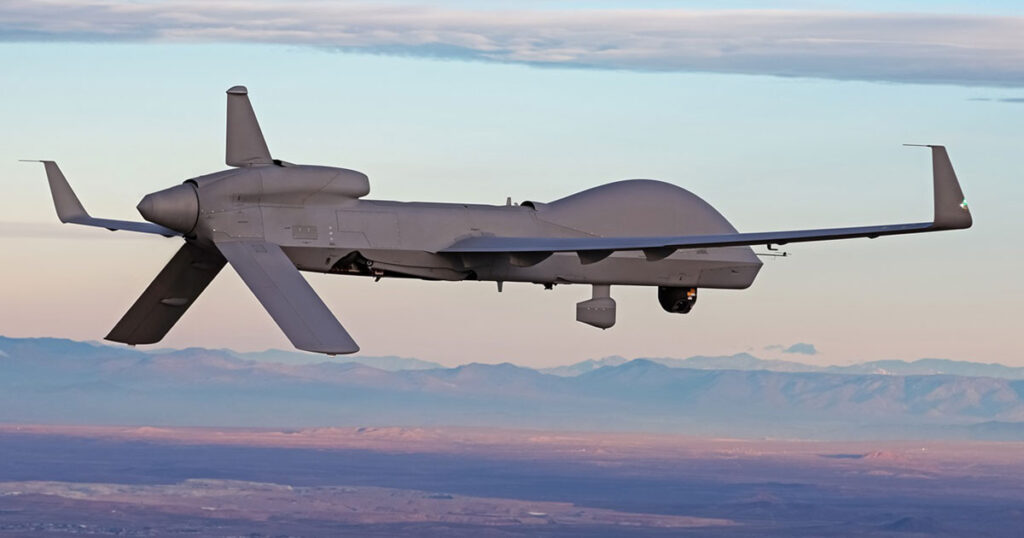
Image: General Atomics
The U.S. Army has awarded General Atomics Aeronautical Systems (GA-ASI) a contract to equip its MQ-1C Gray Eagle Extended Range drone with upgraded electronic intelligence capabilities, strengthening its ability to detect and locate enemy air defence systems.
The new electronic intelligence (ELINT) sensor package will allow Gray Eagle ER aircraft to operate beyond the reach of adversary threats while scanning deep into contested airspace. The upgrade directly supports the Army’s Integrated Air Defence System (IADS) mission, feeding real-time intelligence to ground commanders.
GA-ASI President David R. Alexander said the combination of long-range detection and the platform’s endurance ensures commanders can track when an adversary IADS is active. He added that Gray Eagle’s open systems architecture makes the integration straightforward but operationally significant, according to GA-ASI.
Targeting Enemy Air Defences
The ELINT sensor identifies and geo-locates critical threats essential to Joint Force Operations. GA-ASI will partner with Sierra Nevada Corporation (SNC) and the Capability Program Executive for Intelligence and Spectrum Warfare to integrate advanced radar detection and signal collection technology into the platform.
The upgrade enhances Gray Eagle ER’s value in contested environments where identifying and suppressing enemy air defences is a prerequisite for broader operations. By keeping the drone outside threat envelopes, the Army also reduces risk to crewed aircraft operating in the same battlespace, a key objective in modern manned-unmanned teaming concepts.
A Platform Built for Multi-Domain Operations
The ELINT upgrade is one layer of a broader sensor modernisation effort. Gray Eagle ER has already demonstrated modernised Communications Intelligence (COMINT), Synthetic Aperture Radar and Moving Target Indicator (SAR/MTI) capabilities, and Mobile Ad Hoc Network (MANET) radios across multiple Army exercises.
These capabilities align with the Army’s C5ISR Modular Open Suite of Standards (CMOSS) architecture, a framework designed to allow rapid integration of new sensors, payloads, and weapons as threats evolve. The approach gives programme managers flexibility to adapt the platform without costly redesigns.
Proven in Contested Environments
Gray Eagle ER demonstrated its multi-mission potential during Project Convergence Capstone-5 (PCC-5), the Army’s large-scale modernisation experiment held last year. Operating in an electronically contested environment, the aircraft conducted persistent Detect, Identify, Locate, and Report (DILR) missions while simultaneously providing aerial mesh network support to manoeuvre units.
The exercise highlighted how the platform can bridge communication gaps caused by terrain or range limitations, connecting soldiers and launched effects that might otherwise lose contact. Critically, it did this while remaining resilient to jamming.
PCC-5 also demonstrated the platform’s human-machine interface improvements, which reduce the cognitive burden on operators by automating certain inputs. Gray Eagle ER cross-cued ELINT, COMINT, SAR, and Aerial Tier Network Expansion (ATNE) data during the exercise, boosting force survivability across the Combined Joint Task Force.
Strategic Context
The upgrade reflects broader U.S. Army efforts to modernise its unmanned aerial systems for high-end conflict scenarios. As near-peer adversaries invest heavily in integrated air defence networks, the ability to detect, locate, and characterise those systems from standoff range has become a critical operational requirement. Gray Eagle ER’s persistent endurance and open architecture position it as a central node in the Army’s emerging intelligence and targeting networks.
Source: General Atomics Press Release