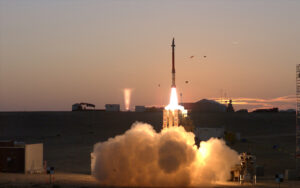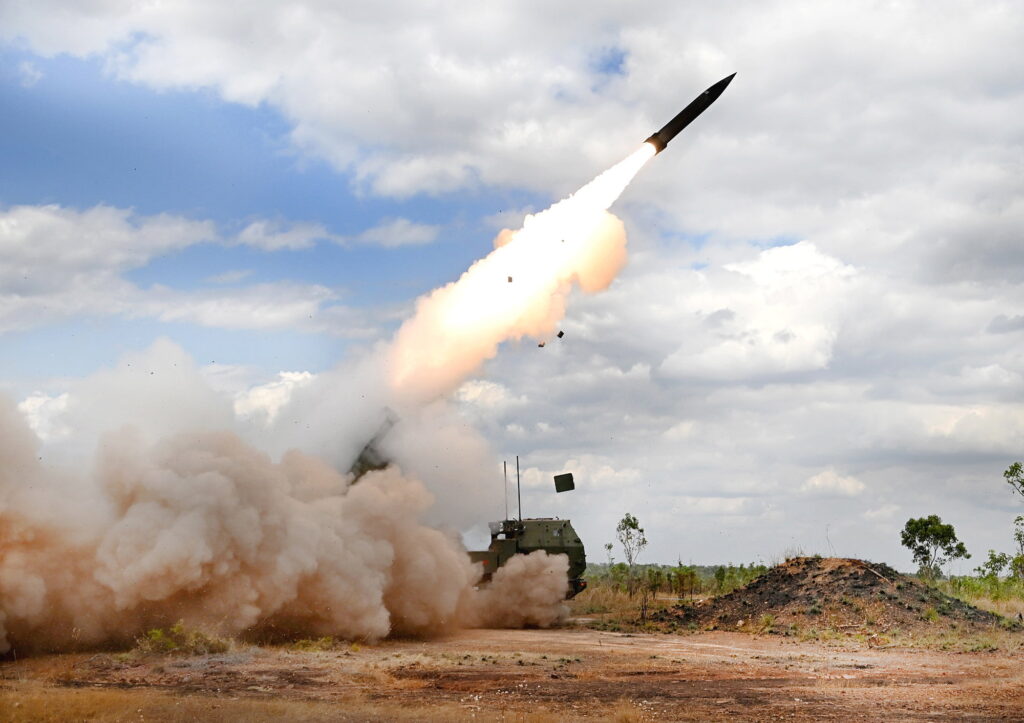
Australian High Mobility Artillery Rocket System (HIMARS) fires Precision Strike Missile (PrSM).
Image: Australian MoD
The Albanese Government has selected the High Mobility Artillery Rocket System (HIMARS) and the Precision Strike Missile (PrSM) for a second long-range fires regiment, committing $2.3 billion over the next decade to sharpen the Australian Army’s strike reach.
The announcement marks a significant step in Australia’s push to field a credible land-based strike force. The new regiment will be based at the Edinburgh Defence Precinct in South Australia, complementing an existing HIMARS capability already embedded in the Army’s order of battle.
Extending the Army’s Reach
The second long-range fires regiment will give the ADF the ability to engage targets at distances of up to 500 kilometres. Future increments of PrSM will extend that range beyond 1,000 kilometres, according to the government.
Defence selected HIMARS and PrSM following a competitive evaluation process. HIMARS already serves with the Australian Army as part of its first long-range fires regiment. The system’s combat-proven mobility and firepower align with Australia’s stated requirement for a deployable, lethal strike capability operating across its northern approaches and beyond.
The ADF demonstrated the platform’s readiness earlier than expected. Australian launchers fired PrSM during Exercise Talisman Sabre 25, two years ahead of the original schedule, signalling the force’s accelerating integration of advanced strike systems.
Strategic Context
The 2026 National Defence Strategy identifies long-range strike as a core ADF requirement. Australia’s strategic environment, marked by rapid military modernisation across the Indo-Pacific, has driven a sustained shift toward longer-range, harder-hitting systems capable of contributing to both sea control and sea denial.
The investment forms part of a broader $37 billion commitment outlined in the 2026 Integrated Investment Program. That funding targets targeting systems, enabling data infrastructure, and long-range strike capabilities across the Royal Australian Navy, Army, and Royal Australian Air Force.
Deputy Prime Minister and Minister for Defence Richard Marles described the decision as a decisive investment in Australia’s long-range strike capability, adding that it delivers on the National Defence Strategy direction to accelerate and expand the acquisition of land-based long-range fires.
Sovereign Missile Manufacturing
Beyond procurement, the government is using the HIMARS expansion to accelerate a domestic missile manufacturing industry. Australia test-fired its first locally produced Guided Multiple Launch Rocket System (GMLRS) missile from an Australian HIMARS launcher this month, a milestone in the country’s push for sovereign munitions production.
Last year, Australia and the United States established a cooperative program for PrSM, laying the groundwork for future domestic production of the missile. Both GMLRS and PrSM will carry Australian industry participation throughout their supply chains, including locally manufactured components and sub-components.
Minister for Defence Industry Pat Conroy said the decision would generate new demand for PrSM within the Army and create further opportunities for in-country manufacture. “We’re already making missiles that can be fired from the HIMARS,” Conroy said, according to the Australian Department of Defence.
Implications
The expansion of Australia’s land-based fires capability reflects a clear doctrinal shift, away from a purely defensive posture and toward a force able to project lethal, precise firepower at operationally significant ranges. Paired with ongoing investment in naval and air strike systems, the second HIMARS regiment positions the ADF as a more capable partner within the AUKUS framework and across its broader alliance network.
Source: Australian MoD