Image: Aselsan
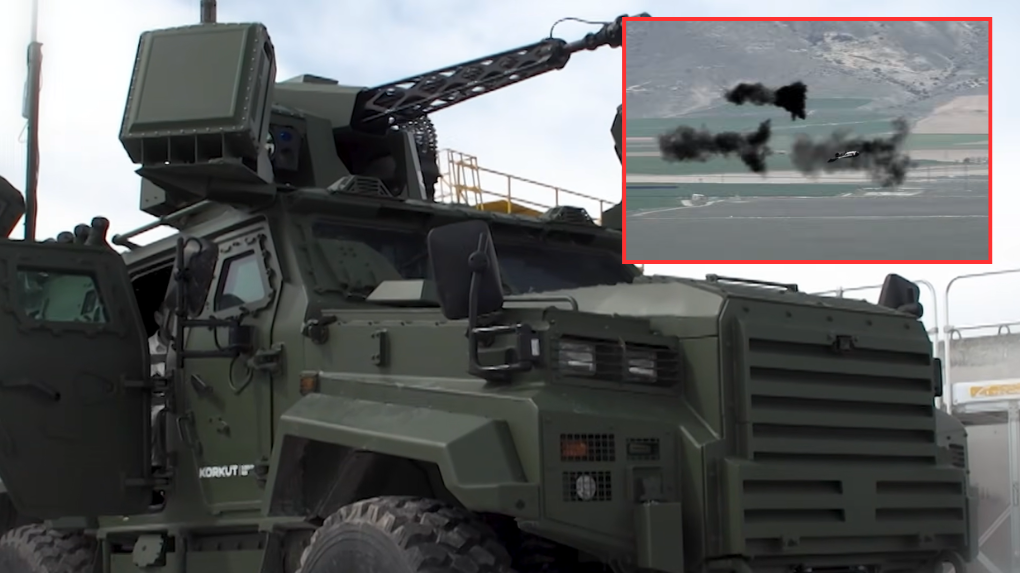
Turkey’s ASELSAN conducted a live-fire demonstration of its KORKUT 25 air defence system this week in Konya, drawing more than 100 senior delegates from 15 countries. The exercise put the platform’s full counter-UAV capability on display across realistic operational scenarios.
A Multi-Domain Kill Chain Tested in the Field
Participating delegations observed every operational layer of KORKUT 25 across end-to-end field scenarios. Both hard-kill and soft-kill engagement methods were tested against modern unmanned aerial vehicle threats, a combination increasingly demanded by defence planners as drone warfare spreads across multiple theatres.
In hard-kill engagements, the system’s AESA-based AURA radar acquired and tracked target drones before the KORKUT 25 cannon system engaged them mid-air. ATOM 25 programmable smart ammunition was used to complete the destruction. The programmable round gives operators greater flexibility against a wider range of drone profiles without modifying the weapon platform itself.
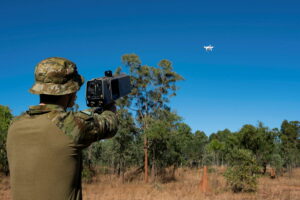
Soft-kill scenarios drew equal attention from attendees. Radar and electro-optical sensors identified drone targets at varying ranges before KANGAL FPV electronic jamming systems neutralised them, disabling their ability to operate without physical destruction. Functional neutralisation of this kind reduces collateral risk and preserves post-engagement intelligence value.
AI Drives the Engagement Chain
The exercise put KORKUT 25’s AI-supported detection and classification capabilities front and centre. The system autonomously identifies and categorises aerial threats before coordinating responses across multiple effectors. This integrated engagement architecture, spanning kinetic and non-kinetic tools, reflects the multi-layered defence doctrine now central to modern short-range air defence.
ASELSAN designed KORKUT 25 to address the rapid evolution of UAV threats, including commercial drones modified for military use and purpose-built loitering munitions. The ability to cycle between hard-kill and soft-kill options within a single engagement chain sets it apart from single-mode counter-drone platforms.
Strong International Reception
According to ASELSAN, the demonstration generated significant interest among attending nations. The event gave foreign delegations direct observation of the system under realistic field conditions, a key factor in export-oriented showcases where paper specifications rarely persuade procurement officials.
The Konya exercise reflects Turkey’s broader push to position ASELSAN competitively in the global counter-UAV market. Demand for layered short-range air defence has accelerated sharply since drone warfare reshaped conflicts in Ukraine and across the Middle East. Nations with limited budgets for high-end air defence are actively seeking affordable, deployable counter-UAV systems, a gap KORKUT 25 is designed to fill. ASELSAN has not released export figures or formal letters of intent from the Konya event, but the 15-nation attendance signals meaningful international interest in the platform.
Source: Aselsan Newsletter