Image: Northrop Grumman
A coast-to-coast manufacturing coalition is driving delivery of the Army’s cornerstone integrated air and missile defence programme, now operational across two theatres.
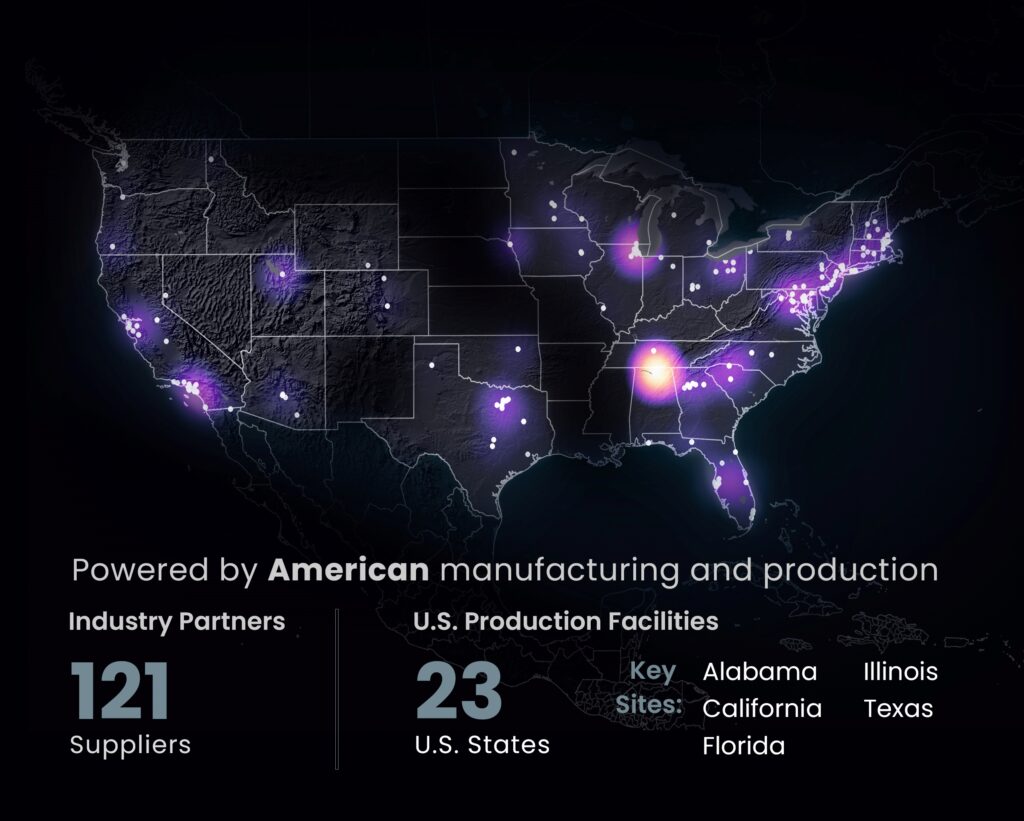
Northrop Grumman is ramping up production of the U.S. Army’s Integrated Battle Command System (IBCS) through a network of more than 120 domestic suppliers, with components flowing from facilities across Alabama, California, Illinois, Texas, and beyond. The mobilisation represents one of the most concentrated drives in American defence manufacturing around a single command-and-control programme in recent memory.
Connecting what was never designed to connect
IBCS is the Army’s programme of record for integrated air and missile defence — and its core proposition is architectural. Rather than fielding a new interceptor or sensor, it stitches together existing and future systems that were never designed to talk to each other, fusing them into a single fire control network. The effect is faster decision-making for warfighters who can now draw on a wider picture of the battlespace in real time.
“IBCS is powered by American manufacturing and production. Our national network of suppliers understand that capability depends on capacity, and investment across the supply chain.” — Kenn Todorov, VP & GM, Command & Control and Weapons Integration, Northrop Grumman
A $20 million anchor in Alabama
The centrepiece of Northrop’s production expansion is the Enhanced Production and Integration Center — known as EPIC — in Madison, Alabama. The 175,000-square-foot facility, underpinned by a $20 million investment, doubles the company’s previous manufacturing footprint in the region. It carries advanced production capabilities designed to flex with evolving system configurations, keeping pace with Army schedules and the growing demands of international partners.
For Dan McClure, Chief Operating Officer at Consumer Fuels, Inc. — an Alabama-based firm in the IBCS supply chain — participation carries weight beyond the commercial. “Together, we are not just strengthening national security,” he said, “we’re driving innovation and creating jobs right here in Alabama.”
Full-rate production — and already in the field
IBCS is not a prototype. The Army has fielded the system operationally in both Europe and the Indo-Pacific, making clear that delivery timelines carry real strategic consequence. Northrop confirmed it delivered more than 140 major end items on schedule last year, keeping operational units equipped without disruption.
At full surge, the industrial network can sustain production of enough systems for 24 battalions per year. Jennifer Lovins, Director at Spectrum Control, said the tempo demands close integration with Northrop’s production teams. QTEC Aerospace — a woman-owned small business headquartered in Huntsville and a Northrop Nunn-Perry award-winning protégé — has been embedded in the programme from day one. “IBCS is a critical programme for our national defence and allies,” said QTEC’s Director of Space and Missile Systems, Steve Cook, “and our employees work hard to continue its success.”
Resilience by design
Single-source dependencies remain a persistent vulnerability in major acquisition programmes. Northrop’s distributed model — drawing on manufacturers across multiple states — directly mitigates that risk. The breadth of the supplier base shortens development cycles, reduces bottlenecks, and gives the programme room to absorb and adapt to new battlefield requirements or technology insertions without breaking stride.
As threat environments in Europe and the Indo-Pacific continue to sharpen demand for credible air and missile defence, IBCS enters that moment with a proven industrial base behind it — scalable, domestic, and already delivering.
Source: Northrop Grumman Press Release