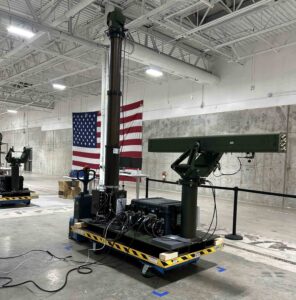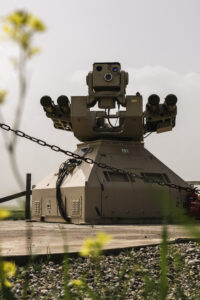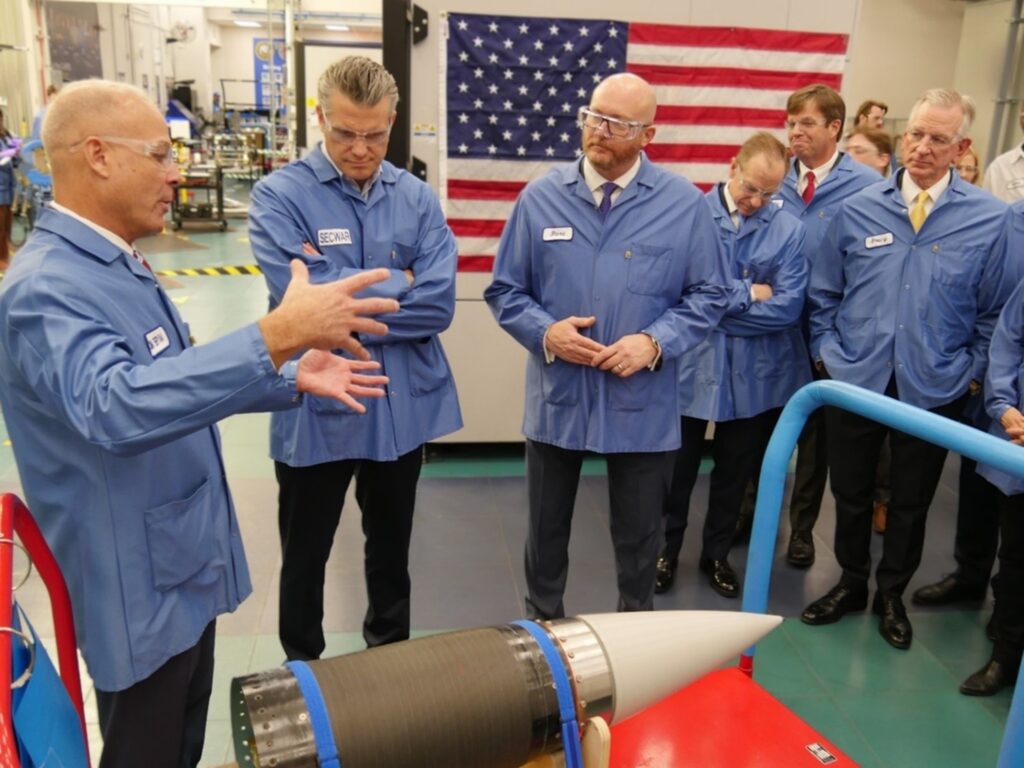
Image: Boeing hosts U.S. Department of War at its PAC-3 seeker factory in Huntsville, Alabama, in December 2025. (Boeing Photo)
The U.S. Department of Defense has signed a seven-year agreement with Boeing to triple production of the seeker component at the heart of the Patriot Advanced Capability-3 Missile Segment Enhancement (PAC-3 MSE) interceptor, in a move designed to eliminate supply chain bottlenecks and scale munitions output for frontline forces.
The seeker, built by Boeing, provides the active measurement data that steers PAC-3 MSE missiles to precision intercepts. Without sufficient seeker production, downstream assembly lines cannot scale — regardless of what prime contractors can deliver.
The deal directly supports a separately announced agreement with prime contractor Lockheed Martin to more than triple its PAC-3 MSE all-up round output. Together, the two contracts represent a coordinated push to expand missile production across every tier of the defence industrial base.
Under Secretary of Defense for Acquisition and Sustainment Michael Duffey said the agreement reflected a fundamental shift in how the Pentagon approaches procurement. “To build a true Arsenal of Freedom, we must strengthen every link in the chain,” he said. “Speed, volume, and a resilient supply chain are paramount.”
The Pentagon frames the Boeing deal as a direct application of its new Acquisition Transformation Strategy. That strategy prioritises engaging suppliers at every level of the industrial base — not just the prime contractors who have traditionally held long-term government agreements. The rationale: without stable, long-term demand signals, lower-tier manufacturers cannot justify investment in new facilities, tooling, or workforce expansion.
The seven-year duration is significant. Long-term contracts give manufacturers the confidence needed to commit to capital-intensive decisions — new production lines, trained personnel, dedicated tooling — that shorter agreements rarely support.
The initiative also sits within the Pentagon’s broader effort to place its acquisition system on what officials describe as a “wartime footing,” prioritising speed and flexibility over the slower, traditional procurement cycle. Duffey said the department was “moving beyond the old model” and forging direct partnerships with critical suppliers to ensure the industrial base could “expand production and deliver decisive capabilities at speed and scale.”
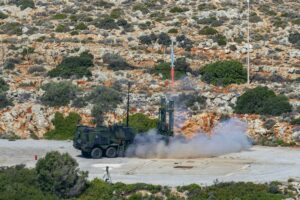
The PAC-3 MSE is among the most capable hit-to-kill interceptors in the U.S. arsenal, designed to defeat ballistic missiles, cruise missiles, and advanced aircraft at extended ranges and altitudes. Demand has surged following high-profile combat use in the Middle East and sustained deliveries to allied nations including Poland, Romania, and several Gulf states.
Tripling seeker output directly addresses a recognised vulnerability: the concentration of critical component manufacturing at a limited number of facilities. Supply chain fragility emerged as a central Pentagon concern following disruptions exposed by the war in Ukraine and rapid drawdown of U.S. munitions stocks.
According to the Department of Defense, the initiative is expected to generate thousands of jobs across the defence industrial base, though specific workforce figures were not disclosed.
Whether the industrial base can deliver at the pace the Pentagon now demands will depend on workforce availability, raw material supply, and the speed at which Boeing can bring expanded seeker capacity online.
Further details of the PAC-3 programme are available via the U.S. DoW and Boeing websites.