Image: Sikorsky Press Release
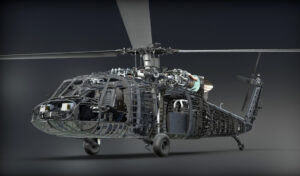
In a major step toward autonomous military aviation, Sikorsky, a Lockheed Martin company, has transformed a UH-60L Black Hawk into an uncrewed utility aircraft system (UAS) named the S-70UAS U-Hawk, the company announced this week at the Association of the United States Army (AUSA) exposition. Developed from concept to prototype in just ten months, the U-Hawk marks a significant evolution of the Black Hawk platform into a fully autonomous, mission-ready system.
A Rapid Transformation from Crewed to Autonomous
The U-Hawk prototype replaces the traditional cockpit of the UH-60L with actuated clamshell doors and a cargo ramp, eliminating the need for pilots and freeing up roughly 25% more internal space than a standard Black Hawk. The aircraft is equipped with Sikorsky’s MATRIX™ autonomy suite and a third-generation fly-by-wire control system designed to deliver low-cost, scalable autonomy for military operations.
“We developed this prototype from concept to reality in under a year, and the modifications made to transform this crewed Black Hawk into a multi-mission payload UAS can be replicated at scale quickly and affordably,” said Rich Benton, Sikorsky vice president and general manager, in a company statement. “The U-Hawk continues the Black Hawk legacy as the world’s premier utility aircraft and opens the door to new capabilities as a UAS.”
Enhanced Cargo and Mission Flexibility
By removing the cockpit and crew stations, the U-Hawk offers a redesigned cabin capable of handling a wide range of payloads — from missile pods and cargo containers to uncrewed ground vehicles (UGVs) and reconnaissance drones. The aircraft can carry up to four Joint Modular Intermodal Containers (compared to two in the UH-60L), transport a HIMARS rocket pod or two Naval Strike Missiles, and accommodate internal fuel tanks for longer endurance.
The platform also supports autonomous “air-ground teaming,” allowing UGVs such as the HDT Hunter Wolf 6×6 to drive directly on and off via its rear ramp. Sikorsky states the U-Hawk can self-deploy over 1,600 nautical miles or loiter for up to 14 hours without refueling, maintaining the external lift capability of 9,000 pounds (4,080 kg) typical of the UH-60 series.
Operators, Not Pilots
Unlike traditional helicopters, the U-Hawk requires no pilot onboard. Operators command the aircraft using a tablet interface that controls everything from startup to shutdown. Mission parameters are entered digitally, after which the MATRIX autonomy system generates a safe and efficient flight plan using onboard cameras, sensors, and navigation algorithms.
A Cost-Effective Step Toward Autonomous Logistics
Sikorsky emphasizes that the U-Hawk leverages existing UH-60 components, reducing costs through fleet commonality and simplified maintenance. “The U-Hawk offers a cost-effective utility UAS by leveraging commonality with the existing UH-60 fleet, and its uncrewed nature reduces both operating and maintenance costs,” said Igor Cherepinsky, director of Sikorsky Innovations.
The conversion program was led by Sikorsky Innovations’ rapid prototyping group, with the first flight of the U-Hawk scheduled for 2026. The company envisions the system supporting a range of autonomous missions, from logistics resupply and missile transport to drone swarm deployment and long-range endurance operations.
As the U.S. Army continues to explore uncrewed and optionally piloted rotorcraft capabilities, Sikorsky’s U-Hawk demonstrates how legacy aircraft can be adapted for a future where autonomy and modularity define battlefield aviation.
Sikorsky Press Release