Defence Leaders’ Future Land Forces 2025 conference might have come to an end, but there’s so much to be positive about.
This year’s iteration has been the biggest and best yet, with 50+ nations from around the world taking part, close to 60 experts in their field giving presentations, and almost 800 delegates drinking it all in.
Our final day started in the same vein as Day Two, with four separate streams of content from which to choose, before we all came together for a closing plenary session to round the event off.
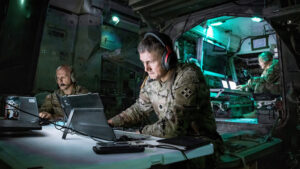
Among the early highlights was a presentation on the British Army’s next-generation tactical communications and information systems. The audience heard about Project Iris, and its effort to make sure “we were delivering the right thing… but also that we were delivering in the right way.”
Highlighting past mistakes, it was pointed out how, for example, because Royal Marines had needed radios that worked when exposed to salt water, that capability had been built into every single unit across all forces.
And as the speaker noted: “Now if one of your Challenger tanks has fallen into the ocean, something has gone terribly wrong.”
Still, building in that functionality (and others like it) meant compromises in terms of cost, weight, and size, resulting in systems that met about 50% of the stated requirements of any given user “and disappointed everyone from day one.”
Going forward, one of the key guiding principles for replacement systems will be incremental and iterative delivery, combined with a recognition that “one size doesn’t fit all” and specific equipment can be tailored to individual force elements’ requirements.
The new approach is focused on “learning by doing” via initiatives such as Project Asgard, with new COTS kit sourced rapidly and provided to a forward-depoyed brigade in Estonia. From there, the plan is to examine what works well, and refine and acquire more of it, and replace what doesn’t.
The aim now is to maximise use of military-off-the-shelf (MOTS) and commercial-off-the-shelf (COTS) kit, minimise the bespoke, and maintain advantage by software upgrades, not hardware as far as is possible.
This call for an iterative approach to development was echoed in another theatre in a Milrem Robotics presentation on UGVs, which talked about distancing troops from high-risk environments.
The speaker talked about a future battlefield where a first line of defence was made up of completely uncrewed systems, a second line was mixed, and the majority of soldiers was in the third line.
“We are not there yet, definitely not, but that is where we are heading,” they said. Recent new capabilities called for on UGVs were CUAS and air defence, adding to existing ISR, casevac, IED-clearance and gun platform capabilities.
And they talked about how remote control of UGVs was improving all the time, referencing a recent test in Sweden where a system was controlled via satellite from almost 900km away. “Was it perfect? No. Did it work? Yes.”
Elsewhere there was a candid presentation from a representative of Task Force Kinded, the U.K. group responsible for rapid procurement support to Ukraine.
One telling insight which spoke to the pace of change was that 70% of systems in the U.K. inventory at the start of the war — less than four years ago, remember — are now deemed “no longer operationally effective.” And the speed of technical iteration, it was noted, is measured in weeks.
“The battlefield was shifting… and we changed too. We tended to demand the capabilities that we needed, not what was being offered,” the audience heard.
Kindred now seldom purchases OTS, the speaker revealed: instead it specifies requirements and expects industry to generate new capabilities to meet those needs. And subcomponents of drones and modularity are key, so you can build the systems you want, Meccano-style.
Elsewhere, the topic of urban warfare came strongly to the fore: a British-led presentation on equipping and training forces to operate in urban environments noted that despite there being much lip-service paid globally to its importance, there was a significant “say-do gap.”
Examples cited of how the status of urban warfare seemed to be a “perpetual afterthought” included the cancellation of the U.S. Marines’ Project Metropolis II programme, and the fact that among more than 30 NATO Centres of Excellence, none focused specifically on the urban environment.
“NATO as a collective has fallen badly behind when it comes to urban environments,” the audience was told. If fighting in mountain, desert, jungle, Arctic, CBRN and amphibious conditions were all deemed to have their own specific requirements in terms or equipment and doctrine, why not urban too?
Other examples given were how the overarching single performance metric for a new U.S. rifle was to be able to defeat body armour at 600 metres; that the turning circle of a Boxer fighting vehicle was 12 metres, when the the width of an average U.K street was 7.5 metres; and how most military vehicles had their main weapons centrally mounted, not frontally, requiring them to be significantly exposed before they could attack around corners.
All this dovetailed nicely with a separate presentation on subterranean warfare in contemporary military operations, with particular reference to lessons identified from Ukraine and Gaza.
In Gaza, the speaker noted, Hamas had essentially used the urban environment as a means of camouflage and defence for its extensive subterranean operations; in fact, Gaza presented a unique triple challenge of urban warfare, underground warfare, and hostage rescue.
There had been a generational evolution in tactics from intra-nation tunnels, to cross-border tunnels, and then, once these had been countered by Israeli countermeasures, to “approach” tunnels which stopped just short of borders but afforded close access, and could be extended at short notice.
Neutralisation countermeasures such as sealing via cement-pouring and clearing via explosives had been countered by the introduction of blast doors to segment tunnels to limit the effectiveness of such measures.
The speaker suggested Hamas had “mastered the art” of tunnel warfare, noting its sophisticated use of civilian boring equipment, and the use of tunnels not just for fighting and troop mobility, but also as prisons for hostages and disaggregated and dispersed manufacturing facilities for weapons.
They suggested a specific subterranean conflict doctrine had to be developed which needed to encompass elements of detection, clearance, and also battle damage assessment.
After a highly fruitful morning the conference came together for a final plenary session, which began with a panel discussion on how best to ensure militaries took a more agile approach in a rapidly evolving battlespace.
Among the insights offered were the following:
“Countering AI and UxS has to be a key part of our plans.”
“We need an innovation hub to help us, but events like this make me think we are moving in the right direction.”
“We need to bring it home to people at the lowest level that we are preparing for war. It’s not just about new systems.”
“We need to return to active manoeuvre to avoid trench warfare situations.”
“Like a football team, you need a good defence before you can have a good offense.”
“You’ll never go fast enough [on innovation] for battlefield commanders.”
“There is some theatre to events like DSEI… but they don’t end up in fielded capabilities.”
“If you’re not using front doors [to producing battlefield solutions] then you’re part of the problem.”
“Within NATO [we need] faster adoption of STANAGS to reflect changes in technology, and industry to work to those STANAGS; it’s the only way we get interoperability.”
There was then a candid presentation on the future of artillery fires which contained the following message: “The politicians don’t want to admit it, but humans will not always stay in the loop.”
Pressed to explain his views further, he predicted full autonomy in some situations for sensing, acquiring and prosecuting targets in the European theatre within ten years, saying: “The technology is there now; we have seen it already.”
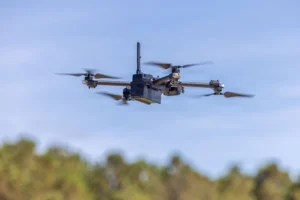
The final topic of the conference was a Ukrainian presentation examining methods of destroying enemy uncrewed aerial systems (UAS) for both strike and reconnaissance using interceptor drones.
The audience heard how the speaker’s air assault brigade had used low-cost drones to take out more than 580 enemy strike and ISR drones since the start of the year alone.
Interceptor drones were a much more cost-effective method than missiles, the audience heard; curved flight path approaches were the most effective way to take out targets that flew at fixed speed and in a constant direction.
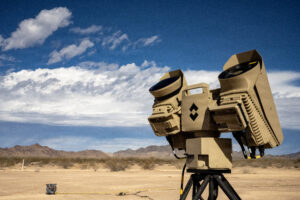
Some of Ukraine’s intercept systems are capable of speeds well in excess of 200km/h (120mph) — they are used in conjunction with digital radars (Robin and Saab Giraffe systems were mentioned) which are moved regularly to try to keep them safe from enemy countermeasures, whose ranges are improving all the time.
Visual digital video-feed data is used in conjunction with these radars for identification to ensure detected drones are foes, not friends, in what is generally a highly contested battlespace.
The speaker said one of the biggest challenges was keeping radars hidden in what was often highly exposed terrain.
And Russian tactics have recently evolved, delegates heard, with the enemy now using drone motherships staying in the rear and dropping swarms of smaller FPV drones. In day-to-day scenarios, Ukrainian operators didn’t usually have the luxury of taking a break and rotating exhausted operators: in such an attritional conflict, standing down drone users created a gap that the enemy could and would generally exploit.
This final presentation was an engaging and fitting end to a content-rich week in Warsaw. Defence Leaders thanks everyone who has participated at FLF25: we look forward to welcoming you back next year!