Image: UK MoD
UK and Germany have advanced plans to jointly develop a family of long-range stealth and hypersonic missiles after bilateral defence talks in Berlin, with the weapons expected to enter service in the 2030s.
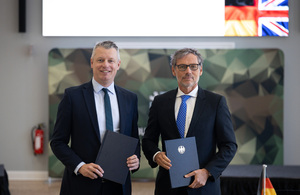
Minister for Defence Readiness and Industry Luke Pollard met Germany’s State Secretary for Armament and Innovation Jens Plötner at the Defence Bilateral Ministerial Group on Equipment and Capability Cooperation (MECC) this week to review progress on the Deep Precision Strike (DPS) programme.
The missiles will be capable of travelling more than 2,000 kilometres and will form a family of future stealth cruise and hypersonic weapons. The programme initially focuses on ground-launched capabilities but will expand to explore air and naval options, delivering long-range deterrence and operational flexibility across multiple domains.
The talks build on the Trinity House Agreement, signed by both nations in October 2024, which established a framework for deeper bilateral defence and security cooperation. According to the UK Ministry of Defence, the German-British cooperation remains open for other nations to join.
Pollard said the programme serves both a military and an industrial purpose. “We are not only arming our military personnel with the best weaponry to act as the strongest possible deterrent to our adversaries, but in doing so we are also building the industrial foundations that will keep both nations at the forefront of defence technology,” he said.
The DPS programme arrives as both the UK and Germany sharply increase defence investment. The UK government is committing 2.6 percent of GDP from 2027 — what it calls the largest sustained defence spending increase since the Cold War — with an additional £5 billion allocated this financial year and £270 billion across this parliament.
Long-range precision strike has become one of the most strategically significant capabilities in modern warfare. Hypersonic and stealth cruise missiles are central to NATO deterrence planning, offering the ability to penetrate advanced air defence systems and strike deep into adversary territory.
A joint programme of this scale positions the UK and Germany as leading architects of Europe’s future strike capability — and sends a clear signal of allied resolve at a time of heightened continental security concern.
You can read more about the Trinity House Agreement via the UK Government website