Image: ARX Robotics
New medium-class ground vehicle combines optional manning, high-speed mobility and software-defined autonomy to address a capability gap in European land forces.
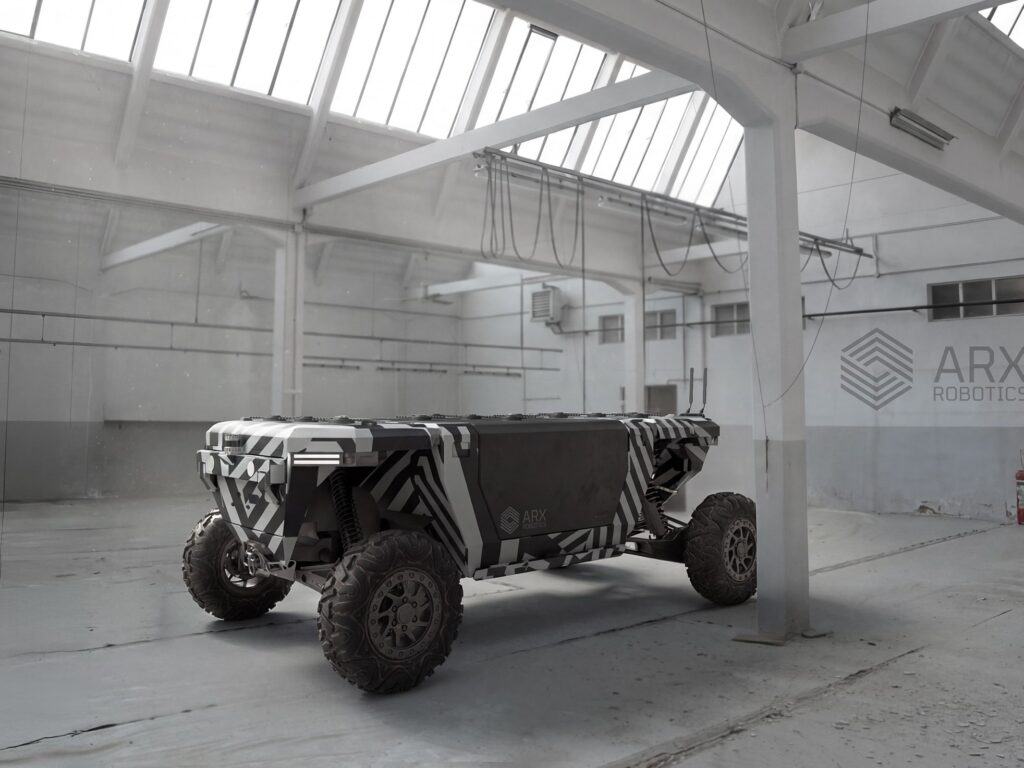
German defence technology firm ARX Robotics has unveiled Hector, a new medium-class unmanned ground vehicle (UGV) designed to deliver greater speed, range and operational flexibility for European land forces, according to an announcement by the company. The platform introduces an optionally manned concept paired with a software-first architecture, positioning Hector as both a robotic system and a scalable land capability.
Hector is intended to address what ARX Robotics identifies as a shortfall in Europe’s current ground robotics inventory: the lack of a mass-producible UGV that can keep pace with manoeuvre units while integrating securely into existing command-and-control structures. By combining crewed and uncrewed operation modes with supervised autonomy, the company aims to offer forces a force-multiplying asset rather than a niche system.
Optional manning and hybrid control
At the core of Hector’s design is its optionally manned concept. The vehicle can be driven by a crew to the edge of an operational area and then transitioned to teleoperation or supervised autonomous control. This approach is intended to extend operational reach, reduce personnel exposure in high-risk environments, and increase flexibility across mission phases.
Hector supports hybrid control modes, including teleoperation, platooning and convoy operations, enabling it to operate alongside both manned and unmanned systems. Human-in-the-loop oversight remains integral to the design, reflecting European military preferences for supervised autonomy in land warfare systems.
Powertrain options and performance
ARX Robotics plans to offer Hector in two powertrain configurations. A combustion-engine variant is optimised for extended range and high-tempo operations, with a reported top speed of up to 120 km/h and an operational range of up to 350 km. This version is aimed at missions where distance, endurance and simplified resupply are decisive factors.
The fully electric variant is designed for missions requiring reduced acoustic and thermal signatures, such as reconnaissance or operations in contested environments. It also enables simplified charging at forward locations. Both variants share a common modular chassis and core systems, allowing forces to standardise maintenance and training.
Software-defined and modular by design
Hector is built around ARX Robotics’ Mithra operating system, which provides the onboard compute and autonomy stack. The software-defined approach allows capabilities to be updated and scaled across fleets without extensive hardware changes, a key consideration for long-term affordability and adaptability.
Open payload interfaces and a growing partner ecosystem enable the vehicle to be configured for a range of roles, including reconnaissance, logistics support and effector carriage. ARX Robotics emphasises that Hector’s design prioritises industrial-scale production, with cost-effectiveness and availability intended to support mass deployment rather than limited trials.
Addressing European operational needs
Rather than presenting Hector as a single vehicle solution, ARX Robotics frames it as a connected ground capability aligned with European interoperability and compliance requirements. The company argues that this approach helps close what it describes as a “mass and tempo gap” in European land forces, particularly as armies seek to integrate unmanned systems into combined-arms formations.
“European land forces need unmanned systems that move faster, go farther, and connect seamlessly into existing command structures,” said Marc Wietfeld, CEO of ARX Robotics, in the company’s statement. “This new platform does exactly that.”
Chief Operating Officer Stefan Röbel highlighted the scalability of the software-centric design, noting that Mithra OS allows capabilities to be fielded and updated across mixed fleets without compromising security or integration.
With Hector, ARX Robotics is positioning itself to compete in a growing European market for autonomous and semi-autonomous ground systems, where speed of deployment, interoperability and the ability to operate at scale are increasingly central to procurement decisions.
Source: ARX Robotics Press Release