Image: © Thales Alenia Space
A Rocket Lab Electron rocket lifted off from New Zealand on 28 March, carrying two European satellites designed to test a new low-Earth orbit navigation layer intended to complement and strengthen the Galileo system.
Two satellites belonging to the European Space Agency’s Celeste in-orbit demonstration mission launched successfully from the Māhia Peninsula, New Zealand, at 10:14 CET. The pair rode atop a Rocket Lab Electron rocket before separating from the launch vehicle approximately one hour later, according to Thales Alenia Space. Mission controllers have since begun early operations, preparing both spacecraft for sustained activity in orbit.
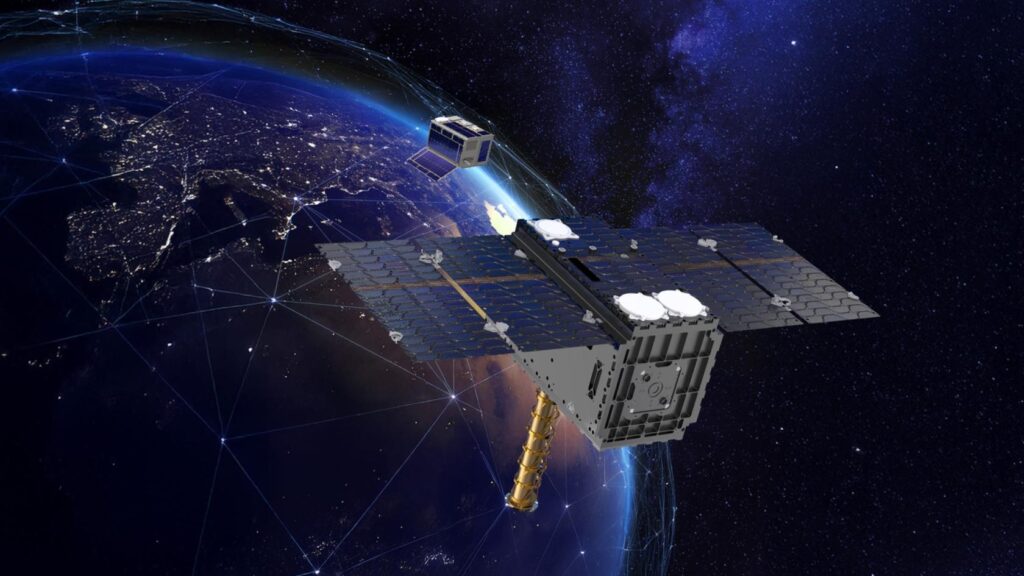
Among the two satellites is IOD-2, designed and built by Thales Alenia Space, the Franco-Italian joint venture between Thales (67%) and Leonardo (33%). Its successful deployment marks a defining moment for European satellite navigation.
A Compact Pioneer with an Outsized Role
IOD-2 is a CubeSat roughly the size of a suitcase, weighing around 30 kilograms. Despite its modest dimensions, it carries significant responsibility. The satellite will validate Celeste’s system design, enable early signal transmission, and de-risk the core technologies required for the programme’s future spacecraft.
Four additional IOD satellites, also under development by Thales Alenia Space, will follow. Each will be larger, carrying roughly twice the mass of IOD-2, and will test innovative signals across multiple frequency bands while demonstrating new service capabilities. Further launches from 2026 onward will complete the Celeste demonstrator fleet, giving ESA the data needed to assess how a LEO navigation layer can operate alongside Galileo and other medium-Earth orbit (MEO) systems.
Strengthening Galileo from Low Earth Orbit
The Celeste mission is currently in its in-orbit demonstration phase. The constellation will ultimately comprise 11 microsatellites in low Earth orbit, built by two European prime contractors, with Thales Alenia Space supplying five of those satellites.
The mission’s central objective is demonstrating how LEO Precise Navigation and Timing (LEO-PNT) can reinforce the resilience and performance of existing MEO navigation services. Celeste aims to prove that a multi-orbit architecture can deliver centimetre-level positioning accuracy, stronger resistance to jamming and spoofing, and very low latency through ultra-fast signal acquisition, capabilities that current standalone MEO systems cannot fully guarantee.
Those attributes carry direct defence and security implications. Jamming and spoofing of GNSS signals remain persistent threats in contested environments, and a LEO layer would provide redundancy and signal resilience at a time when interference incidents are increasing globally.
Enabling a New Generation of Critical Applications
Beyond defence, Celeste carries broad strategic significance. The programme is designed to underpin applications including highly autonomous vehicles, unmanned aerial and maritime systems, Internet of Things networks, and next-generation 5G and 6G telecommunications synchronisation.
Critically, it targets environments where current systems routinely struggle, among them urban canyons, dense foliage, polar regions, and indoor spaces. Providing reliable positioning across these conditions is increasingly important for civilian infrastructure, emergency services, and military mobility.
Hervé Derrey, President and CEO of Thales Alenia Space, welcomed the launch. “As demand for precise positioning continues to grow, space-based navigation systems such as Galileo need to be complemented by multifrequency satellites in low Earth orbit,” he said. Derrey added that the Celeste programme represents a major step forward for next-generation applications, whilst also creating new opportunities in export markets.
Thales Alenia Space posted revenues of €2.36 billion in 2025 and employs more than 8,000 people across 14 sites in seven European countries. The company brings 50 years of experience across space systems spanning telecommunications, navigation, Earth observation, and defence.
Source: Thales Press Release