Image: BAE Systems
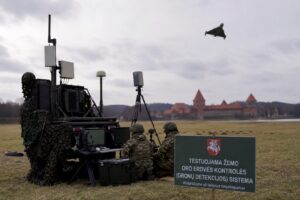
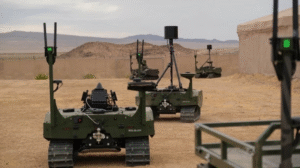
A team of UK-based engineers at BAE Systems is rapidly developing a new counter-drone system — moving from concept to live-fire testing in under a year — as hostile drone activity against civilian and military infrastructure intensifies globally.
The BAE Systems Anti Threat System, or BATS, combines software-driven command and control, electronic warfare, and kinetic measures to detect and defeat uncrewed aerial threats. Work began in October 2025. System testing is expected as soon as next month, with live-fire trials scheduled for early summer.
Tackling the Cost Imbalance
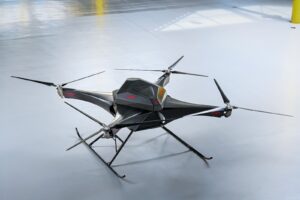
The drone threat has created a stark economic problem for defenders. Intercepting a low-cost hostile drone with an expensive missile is neither sustainable nor scalable — and BATS targets that asymmetry directly.
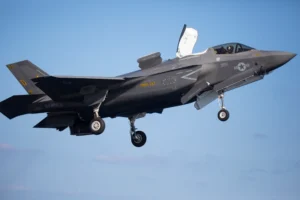
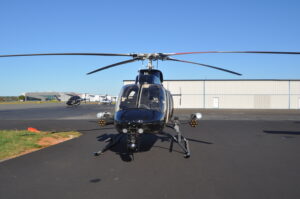
The system is designed to reduce customer reliance on costly munitions by instead deploying smart software and electronic warfare measures as primary response tools. Its open architecture allows operators to plug in sensors and effectors from air, land, and sea domains into a single interface — adaptable across airports, military bases, urban centres, and national borders.
Andrea Thompson, Group Managing Director at BAE Systems’ Digital Intelligence business, said: “Drone incursions are a clear and present issue, putting citizens, military personnel and infrastructure at risk. The technology evolves faster than traditional defence systems can respond, with new behaviours, payloads and tactics emerging almost daily. That’s why we’re moving at pace to build a new system to support our customers in their efforts against this very urgent problem,” according to BAE Systems.
How It Works
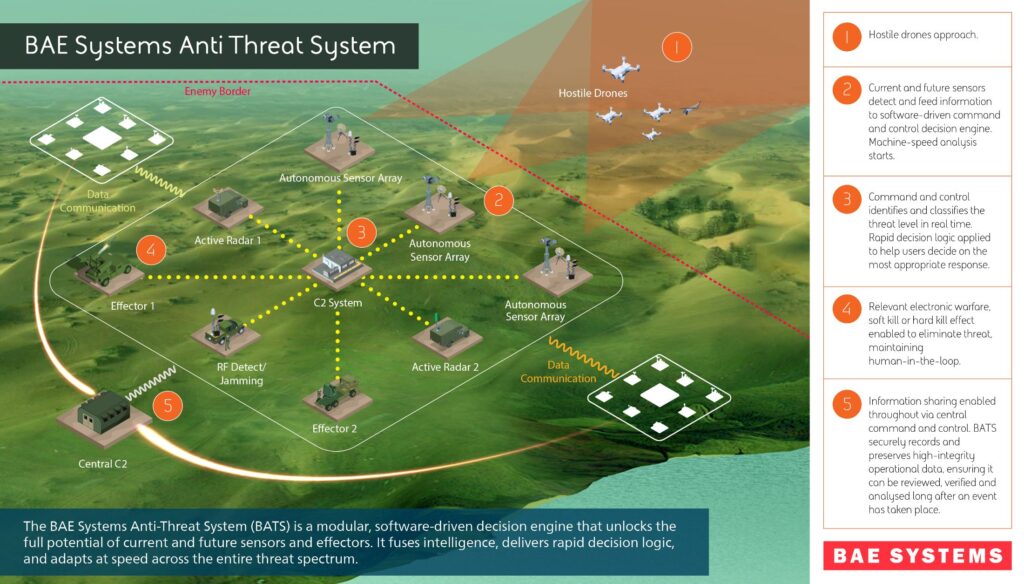
Image: BAE Systems
When deployed, BATS fuses intelligence from multiple sensor layers into a central data core, classifying threats in real time and generating rapid decision-support logic. Operators are then guided toward the most appropriate response — fast.
The decision engine is scalable and software-driven. Crucially, the open architecture means customers can integrate both current and future counter-threat technologies as they emerge, without replacing the core system.
Experts from across BAE Systems’ air, land, and maritime divisions have fed into the programme — a cross-domain approach that broadens BATS’s operational relevance from day one.
Why It Matters
Drone incursions into restricted airspace have become a persistent security challenge across NATO member states. Uncrewed systems have repeatedly breached perimeters around airports, military installations, and critical national infrastructure throughout Europe and beyond. Governments and defence ministries have been pressing industry hard for scalable, cost-effective answers.
BATS represents BAE Systems’ response to that pressure — and a wider shift in how major defence primes now approach fast-moving threats. Traditional multi-year procurement cycles are increasingly giving way to agile, software-first development models built to match the pace of adversarial innovation.
If trials proceed on schedule this summer, BATS will stand as one of the faster concept-to-testing turnarounds in recent British defence history — and a potential template for future rapid-capability programmes.
Further details on BATS and BAE Systems’ Digital Intelligence work are available on the BAE Systems website.