After a whirlwind opening, Day One of Global Defence Aviation 2025 (GDA25) has come to a conclusion, and what a terrific start it has been!
Across three days GDA25 is expecting to welcome more than 900 delegates and 100-plus industry exhibitors from more than 85 countries worldwide, here to enjoy a packed agenda that features more than 35 speakers, all experts in their field.
Day One was a plenary session, and we kicked off in fine style with a timely reminder of the relevance of these discussions; we learned how recent incursions into Polish airspace by Russian drones have brought a note of even greater urgency into national modernisation efforts.
The conference audience heard how Poland is now seeking innovations across very short timescales to evolve its air defences and improve capabilities to counter these types of threats.
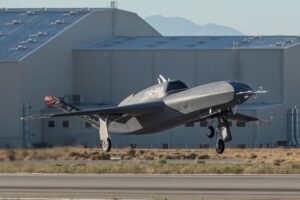
There was a presentation from Leonardo on the company’s vision of how best to secure tactical superiority in the modern multidomain battlespace, which among other things included reference to its ongoing Proteus autonomous uncrewed air system (UAS) programme being developed with the Royal Navy.
The first flight of this RN system will take place before the end of 2025 with a roadmap in place for further development. The UAS has been designed with a modularised payload bay to potentially offer a range of missions; those mentioned here included intelligence, surveillance and reconnaissance (ISR), anti-submarine warfare (ASW) and logistics.
There was also discussion of how the future of the U.K.’s rotary-wing capabilities are set to develop, with particular reference to the procurement systems for platforms.
This year’s Strategic Defence Review (SDR) has heralded a significant streamlining behind the scenes, with the appointment of a National Armaments Director and accelerated acquisition-speed targets to “break the single-silo approach” of the past.
The planned cultural mindset shift is set to continue when the U.K. Government publishes its Defence Investment Plan this December, which should help flesh out details on issues such as the future balance of heavy-lift versus medium-sized rotary-wing platforms for the British Army, for example.
Presentations from France left little doubt that its military leaders see a key role for crewed helicopters in the years ahead, despite a planned “dronisation” of its armed forces.
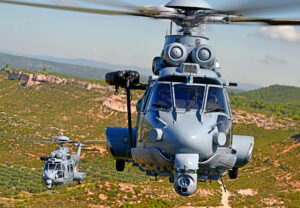
Progress is being made on a manned-unmanned teaming (MUM-T) capability for its H160M Guépard platform in conjunction with Thales and Airbus; the first prototype flew last July, and delivery of the first operational system is expected in 2029.
Airbus itself gave a talk outlining how it was seeking to position itself going forward as more of a military support organisation than just an industry partner, increasing platform availability and responding in a more agile way to end-user requirements via embedded on-site operations.
It is already doing this via its Military Support Centres in France, Spain, and Germany, and the firm is open to rolling this approach out further to other partners going forward.
In the next 18 months Airbus will be testing new Air-Launched Effect (ALE) systems from rotary-wing platforms with all three nations, citing increased survivability via greater stand-off range, better information-gathering capabilities, and enhanced mid-mission flexibility as the chief advantages.
Later, an illuminating presentation on the modernisation of the Royal Canadian Air Force really brought home both the scale of what was being undertaken, and the challenges posed by the environment in which it operates.
A huge recapitalisation will see virtually every aircraft in the RCAF fleet being renewed between 2026 and 2032, and some of the sheer distances involved introduce additional complications, as does the demanding environment.
One cited example was that some of the bases the RCAF has to support in the High North lie geographically closer to Moscow than Ottawa! Another was that some rotary-wing assets need to be able to cold-start unassisted after 24 hours sitting in conditions of -40C (or -52C assisted).
And the “tyranny of distance” has to be factored into almost every facet of operations. Our speaker described the future desirability of being able to provide rescue kits from remote-piloted air systems (RPAS), for instance, in vivid terms.
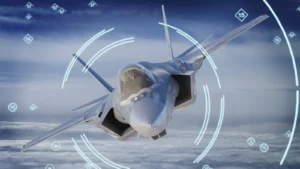
In some locations, were a F-35 pilot forced to eject, they might be looking at a 24-hour wait before a crewed asset could reach them to effect a rescue. And as he pointed out, “That’s a long time to be surrounded by polar bears, wondering if you’ve made good choices in your life.”
We heard about progress being made by the Czech Air Force (CAF) in its modernisation programme; the CAF is acquiring UH-1Y Venom and AH-1Z Vipers. In spite of battling red-tape delays, the force is making big strides.
It looks set to achieve Initial Operating Capability (IOC) — in other words, 70% of training completed and 70% platform availability — by 2026 and Full Operating Capability (FOC) by 2028. Usually it would wait until FOC to declare its aircraft available for NATO operations, but it will bring that forward 24 months if called upon.
Its pilots have also been practising using the aircraft for counter-UAS missions in the simulators, taking advice from their Ukrainian counterparts; live-fire exercises for these missions will come next year.
As it transpired, Ukraine turned out to be a resilient theme towards the end of Day One of GDA25. First we had some insights from a British perspective of how militaries everywhere should be adapting to make use of emerging tactics from Ukraine, which had become a de facto “live laboratory for modern warfare.”
And a packed auditorium took that advice to heart as it listened to an account direct from that arena, with a presentation on Ukraine Army Aviation’s experience of using helicopters against drones and loitering munitions.
We heard how Ukrainian citizens have had to endure more than 2,200 hours of constant alarm and continuous threat from the skies, and how the threat from drones had increased exponentially across the last three years.
Between September and December 2022 about 600 drones were launched against Ukrainian targets, of which 430 were intercepted. Fast-forward to the period between January and September this year, and those figures were 38,713 launched and 34,127 intercepted, respectively.
For Russia, the advantages of using drones include their economic asymmetry — shooting them down with missiles is expensive — and their engagement difficulty, because the Shahed drones fly low and slow, making them tricky to detect, and can be manoeuvred real-time in flight to avoid defensive countermeasures.
But we also heard how Ukrainian helicopters, operating alone or more effectively in two-platform scout-and-strike teams, had achieved considerable success against them, chiefly using 7.62mm calibre machine guns.
In the calendar year 2024 more than 4,500 enemy drones had been destroyed, and in 2025 to date that figure already stands at in excess of 3,500 UAS targets downed. And at an average of 105 rounds-per-kill, crewed helicopters have proved more effective than any other method, despite the hurdles posed by night operations and bad weather.
This hugely detailed and clear-eyed presentation was the perfect way to wrap up a wonderful first day at GDA25… we hope and expect that tomorrow’s Streams Day will prove to be just as informative.