Image: Lockheed Martin
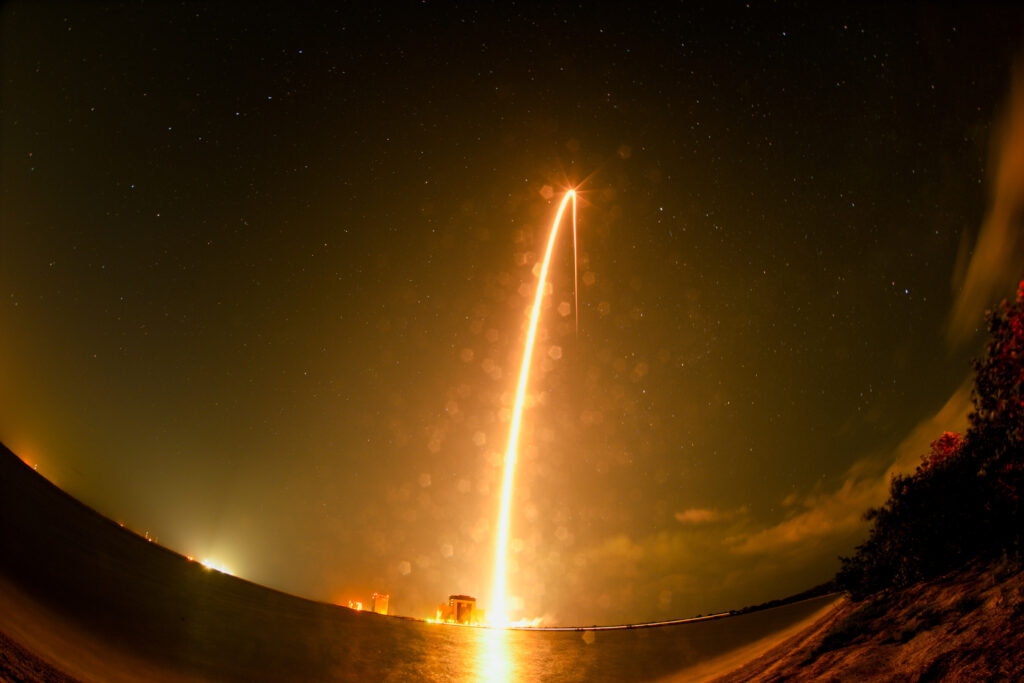
GPS III SV10 lifts off from Cape Canaveral, closing out a decade-long build programme and paving the way for the more capable GPS IIIF generation.
The United States Space Force and Lockheed Martin completed the GPS III satellite constellation on Tuesday with the pre-dawn launch of GPS III Space Vehicle 10 (SV10), the tenth and final spacecraft in the series.
The satellite lifted off from Cape Canaveral Space Force Station at 2:53 a.m. Eastern time, according to Lockheed Martin. It acquired signal shortly after separation and is now in checkout operations at Lockheed Martin’s Denver facility ahead of formal handover to the GPS operational control network.
Optical Crosslinks and a Smarter Constellation
SV10 carries an optical crosslink demonstration payload, one of its most strategically significant features. The technology enables GPS satellites to communicate directly with one another in orbit, removing reliance on ground relay infrastructure. That capability increases on-orbit resilience at a time when adversaries are developing sophisticated electronic warfare and counter-space systems. The satellite also hosts a demonstration Digital Rubidium Atomic Frequency Standard clock, an advanced timekeeping instrument that could inform future precision navigation architectures.
GPS III satellites collectively deliver three times greater accuracy and eight times stronger anti-jamming performance compared to their predecessors. They also carry M-Code signals, encrypted positioning data reserved for military users, which provide secure navigation in contested or denied environments.
Military and Civilian Stakes
The military implications are substantial. Precision positioning underpins modern warfare, from guided munitions and close air support to logistics and troop coordination. Anti-jamming resilience is increasingly critical as adversaries continue to expand their electronic warfare capabilities. For the roughly six billion civilian users who rely on GPS daily, the benefits are quieter but no less significant. Improved accuracy sharpens smartphone navigation, accelerates emergency response location data, and provides more stable timing signals for financial markets and telecommunications networks.
SV10’s launch marks the fourth consecutive GPS satellite delivered on an accelerated schedule, a logistical achievement Lockheed Martin has highlighted as evidence of its ability to sustain rapid on-orbit delivery.
GPS IIIF: The Next Generation
With the GPS III programme now complete, Lockheed Martin has shifted its focus to the GPS IIIF block, currently in production at its Denver, Colorado facility. The company holds contracts for 12 IIIF satellites. The IIIF generation will introduce Regional Military Protection, a capability that provides more than a 60-fold increase in anti-jamming performance for warfighters in specific theatres. That level of hardening reflects growing concern within the Pentagon about electromagnetic spectrum competition and the vulnerability of space-based assets. Lockheed Martin says it is integrating augmented reality tools and digital twin modelling into the IIIF production process to accelerate build timelines.
Vice President of GPS at Lockheed Martin Fang Qian said: “By launching SV10 into orbit, we’re not only adding to the resiliency of today’s GPS capabilities, we’re opening the door to the next generation of GPS IIIF satellites that will provide greater resiliency and serve as the backbone of the GPS constellation for years to come.”
A System the World Depends On
More than 30 GPS satellites currently operate in orbit. The constellation underpins navigation, timing, and positioning services across military, civilian, and commercial domains worldwide, making its continued modernisation a strategic priority for the United States and its allies.
Source: Lockheed Martin Press Release