Image: Army Sgt. Duke Edwards via US DoW
A new enterprise agreement centralises America’s fragmented counter-UAS procurement under a single platform, marking the most significant shift in drone defence acquisition in years.
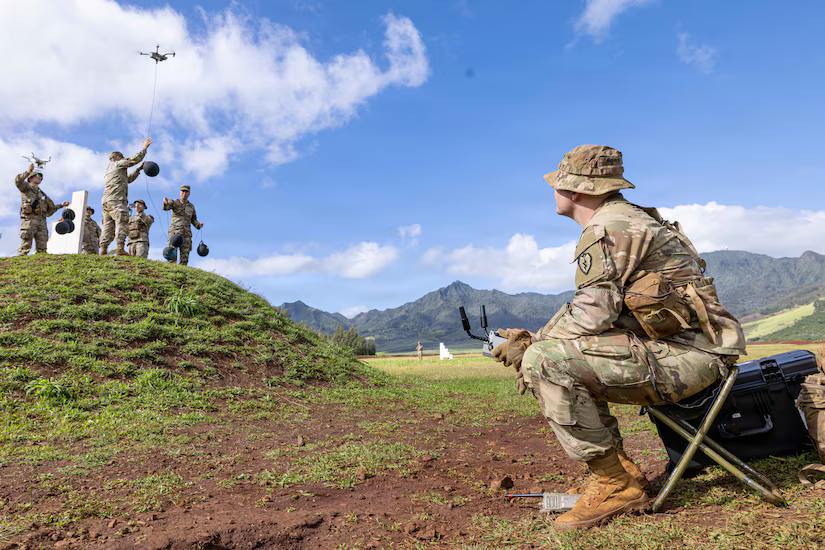
The United States military has awarded a landmark $20 billion enterprise contract to consolidate counter-unmanned aircraft system (C-UAS) command and control across the Department of Defence and federal agencies. The agreement, championed by Joint Interagency Task Force (JIATF) 401 and awarded by Army Contracting Command-Aberdeen Proving Ground in Maryland, centres on Anduril’s Lattice platform as the common C2 backbone.
The move directly tackles a long-standing interoperability problem. Until now, fragmented contracts and incompatible systems have prevented military and federal law enforcement operators from sharing data in real time or coordinating responses to drone threats at speed.
Breaking Down Silos
Army Col. Tony Lindh, JIATF 401’s deputy director of acquisitions, said the agreement represents a decisive shift in how the government fights the drone threat. “This is a decisive move against a pervasive and growing threat,” Lindh said, according to the task force. “This agreement provides common air domain awareness through a proven command-and-control platform — Lattice — allowing us to build a cohesive, agile and formidable defensive ecosystem.”
Lindh added that the contract offers “a clear path to true interoperability across the War Department and our interagency partners” for the first time.
By consolidating procurement under one vehicle, the Pentagon expects to eliminate duplicative purchases, reduce dormant contracts, and improve pricing transparency. Officials say a unified tracking mechanism will govern all related acquisitions going forward.
Ukraine as a Catalyst
The contract’s urgency reflects hard lessons from active conflict. Army Brig. Gen. Matt Ross, JIATF 401’s director, cited a visit to Ukraine as pivotal to his assessment of the threat.
“Based on our testing and evaluation, it became clear that a common command-and-control system is needed to effectively counter adversary drones,” Ross said. “These results were confirmed during my visit to Ukraine, when I saw firsthand how drones have changed the modern battlefield.”
Ukraine has become an accelerated testing ground for drone warfare, where both sides deploy thousands of first-person-view and loitering munition systems daily. The conflict has reshaped Western military thinking on air domain awareness and layered defence.
Speed Over Bureaucracy
Ross framed the contract as a procurement reform as much as a capability upgrade. “We are cutting through red tape and delivering top-tier technology to our warfighters at the speed of relevance,” he said.
The enterprise vehicle allows for rapid procurement and deployment without the delays associated with managing dozens of individual contracts. Officials argue this agility is critical as hostile drone technology evolves faster than traditional acquisition cycles can match.
Lattice, developed by defence technology firm Anduril Industries, is a software-defined system that fuses sensor data and automates threat response across a distributed network. Its selection as the common platform signals growing Pentagon confidence in AI-enabled, software-first approaches to contested airspace.
Strategic Implications
The contract marks a broader philosophical shift in US defence acquisition — away from hardware-centric, platform-specific purchasing and toward adaptable, networked software solutions. With drone threats proliferating from near-peer adversaries and non-state actors alike, Washington is betting that shared infrastructure, not siloed capability, is the foundation of effective defence.
JIATF 401 was established specifically to accelerate C-UAS solutions across government. This agreement represents its most significant programmatic action to date.
Source: U.S. DoW