What more pertinent topic could there be to wrap up this year’s conference than the vital role played by resupply and combat engineering in defending Ukraine?
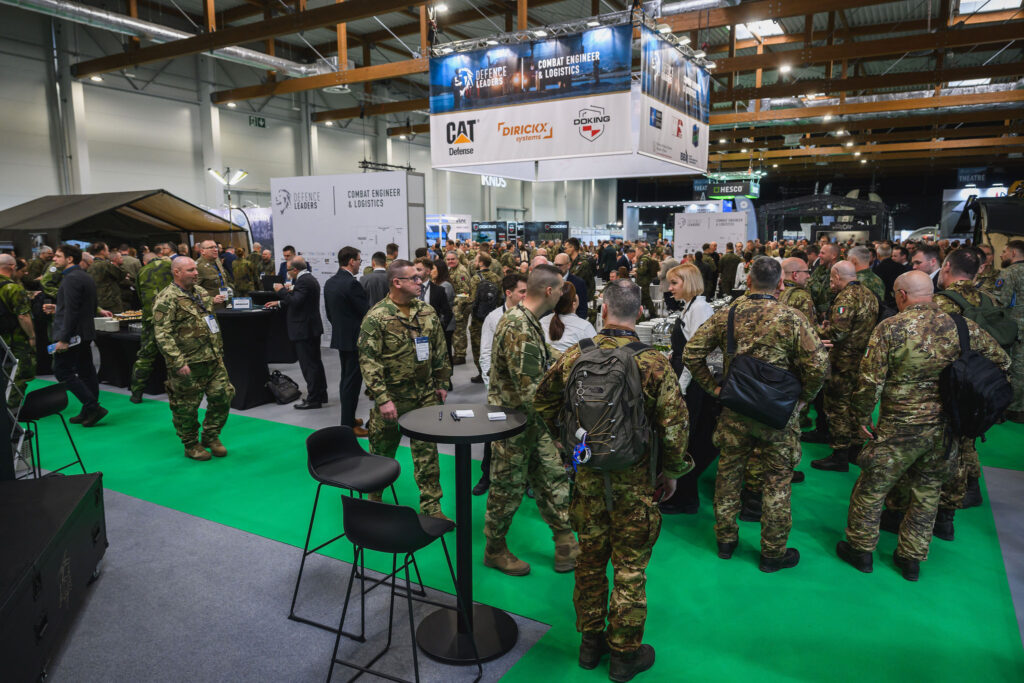
The closing presentation rounded off a magnificent few days in Krakow, Warsaw, which has brought together more than 1,250 delegates representing more than 50 nations around the globe.
We’ve welcomed 130-plus firms exhibiting in the main hall, and enjoyed insights from more than 90 speakers presenting on a range of topics from aerial sustainment and runway repair to the role of engineers in employing and combatting urban and subterranean warfare.
We began our final morning in streams again; today early topics took in counter-mobility, force protection, contracting and digitalisation, among others.
In one theatre we began with NATO LANDCOM’s perspective on counter-mobility, including the issues of drone resilience.
The speaker noted that Ukraine and Gaza had seen a return to large-scale operations “consuming resources at rates we didn’t anticipate” and helping us relearn lessons on the battlefield, but he added: “Everything we are learning is a double-edged sword.”
For instance, remote control is simultaneously a means of increased security, with an ability to perform tasks without exposing sappers to fire, and a threat, with drones’ range and kinetic abilities meaning there is no longer any such thing as a safe rear area.
“We are returning to subterranean warfare,” he said. “The new reality is that the safest place is underground. Dirt is safe, and it is dirt cheap!”
Meanwhile, for combat engineering tasks, he said one soldier was now basically only constrained by the number of drones or UGVs that could be attrited and resupplied, yet “…they are limited by numbers, by power, and spectrum; they need the logistics tail to be able to bring swarms of them forward as they attrited.”
He also said that while there was a danger of being overwhelmed by the swathes of data being fed back by remote systems “drones are a mainstay and a battlefield reality,” adding that as such they would exert a significant drain or draw on supply chains.
The presentation included examples of specific UGVs that had been used in combat engineering environments, including the THeMIS, the Uran-6 demining system, and the Visliuk razor-wire deployer used in Ukraine, as well as the Robdozer used for earthworks by the IDF in Gaza.
The speaker also cited how Israel had used uncrewed air and ground systems for ISR missions and to map tunnel networks in that conflict, too.
Addressing the issue of countermobility, he talked about the importance of dynamic defences, for example with robotic systems repairing defensive lines by relaying minefields, without endangering soldiers. He remarked: “Don’t send a sapper to do a machine’s job.”
But the speaker warned: “The enemy is innovating just as fast as we are…Robotic counter-mobility has been an equaliser against numerically superior forces; the challenge is to keep the advantage on our side.”
Barriers in urban environments had to be considered in three dimensions, with underground elements, and even in four dimensions: “Just because it wasn’t there 12 hours ago, doesn’t mean it’s not there now.”
And as a consequence, real-time situational awareness was now crucial. Meanwhile, barriers without associated armed defences and which didn’t take account of drones weren’t barriers at all, just “annoyances.”
He said it was imperative that Allied forces adapted their doctrines and tactics to keep pace with new realities. “Doing the same thing we have been doing for the last 20 years is not sufficient any more.”
He added: “Doctrine is not ad hoc, but neither is it written on tablets of stone… we need to learn the right lessons and not just gloss over what we will face in reality.”
And his closing reminder was: “LANDCOM doesn’t own anything, doesn’t buy anything: that’s up to nations.”
In a separate presentation, we heard about Latvia’s efforts in installing its section of the Baltic Defensive Line (BDL), the bid to deter and deny Russian invasion with a physical barrier along the borders of the three Baltic states.
Setting the scene, the speaker informed the audience that Latvia was spending 4.9% of its GDP on defence in 2026, with a significant portion of that expenditure going into the BDL.
The Latvian section stretches for about 450km; roughly 280km Russian-facing, and the rest bordering Belorussia. Latvia’s BDL effort began in 2024 and it’s envisaged its initial minimum capability phase should be completed by the end of 2028.
Early efforts were spent getting ready to secure existing road and rail border crossings; while they cannot be sealed off in peacetime, enough materiel has been put in place to be able to do so rapidly if a crisis starts to develop.
The ‘zero-line’ defensive border consists of an anti-tank ditch and 30 metres of ‘dragon’s teeth’ countermobility structures… more defences will be installed within a 30km boundary stretching back into Latvia from the zero-line over time in ensuing phases of construction.
To this end, about a year was spent making the case politically and to industry and civilians about the necessity for such measures; this culminated in a law being passed allowing compulsory expropriation of land on the border and within the 30km zone as necessary to facilitate installing further BDL measures.
The zero-line BDL land appropriation measures have already been passed and come into effect; phases two and three involving land further back are anticipated in March and December this year, respectively.
Civilian contractors are being employed to help install the BDL measures, as not enough engineering capability exists within the armed forces alone; extra military engineering and logistics capabilities are being developed and acquired in tandem with this ongoing effort.
The BDL will be enhanced over time with additional measures including mine-throwing systems. Also Latvia is standing up a next-generation anti-tank mine production facility, expected to be operational in 2028.
Asked when the BDL would be completed, the speaker admitted this was unclear, and he said still more funding would be needed; his guess was perhaps in 2030.
As to the utility and motivation behind the BDL concept, the speaker was unequivocal: it was about allowing the nation’s citizens to continue to live their normal lives behind the defences.
Deterring and preventing an incursion was paramount; as he noted: “Lost land is very hard to regain — it takes time, it takes resources, it takes blood. We are looking to stop the enemy at the first inch.”
Elsewhere attendees enjoyed a presentation on survivability and the modern use of decoys in warfare from the perspective of the French Army.
The speaker noted that decoys were once again becoming important after a period in which they had fallen out of use among Western armies. He said the reason for this was chiefly that they had enjoyed unrivalled aerial dominance in recent decades.
However, this was no longer the case, thanks to widespread drone use and an increasingly transparent battlefield, coupled with sophisticated long-range strike and ISR capabilities no longer only the preserve of the most sophisticated military forces.
In terms of decoys’ utility, the audience heard studies had shown that a 1:1 ratio of decoys to assets could reduce losses by 40%; a 3:1 ratio could increase that figure to 50%. What’s more, using decoys to draw fire can enhance combat troops’ ability to detect enemy targets by about 28%.
Nowadays, sophisticated multi-spectral decoys are capable of mimicking platforms not just visually but also in terms of thermal and electromagnetic signatures. But even simple decoys retain utility, as not all ISR assets field sophisticated sensors.
One suggested specific example where decoys can prove invaluable is for wet-gap crossings, often regarded nowadays as particularly vulnerable in terms of drawing enemy attention and fire.
It was suggested that three dummy crossing sites should be staged against each real one, including the use of decoy USVs, sensors, and MANPADs, with bank earthworks and smoke routinely deployed for added realism.
In terms of where responsibility lay for decoys within the military arena, the speaker suggested that engineering and logistics was a natural fit, with decoy-laying complementary to terrain-shaping and force protection.
He said the French Army was stepping up its activities in this area generally, including high-low sophistication mixes and a specific focus on their use to help protect logistics hubs and command-and-control centres.
In another theatre there was also an informative session on modern minelaying and particularly mine-clearing as part of combat operations. The speaker expressed concern that not enough training had been conducted in this area over the past 25-30 years.
He suggested that recent drone developments had made the concept of minefield clearance without accompanying air defences almost meaningless, and said forces needed to make sure their breaching equipment could both reach deep enough into the ground and clear corridors wide enough to be meaningfully useful.
Mine-laying using drones was becoming commonplace in Ukraine, but it was feared that these munitions would not self-deactivate after a defined time duration, and would eventually pose an ongoing danger to civilians.
Key takeaways were that forces should not just await next-generation technology, but use heritage ordnance to build capability, and there were no quick-fix technological solutions.
Mine use should be a normal part of military planning, the speaker said, and legality issues could not be ignored. He suggested in light of recent developments, users in many countries were likely to be privately debating whether to continue to adhere to existing anti-personnel mine bans.
He concluded: “Mine-breaching demands high levels of cooperation. If you are going to tackle a big minefield, it will take a huge amount of time. Without training, you will fail before you start, because it is a very complex operation.”
Finally, after lunch conference delegates came together for closing plenary sessions, including presentations on host-nation support, perspectives from nations across the globe including Australia and the United States, and of course more insights from the logisticians and engineers helping to defend Ukraine.
It was a great conclusion to a great event. Defence Leaders would like to extend its sincere thanks to all who have taken part and made Combat Engineer & Logistics 2026 such a success. We hope to see you all again next year in Poland!