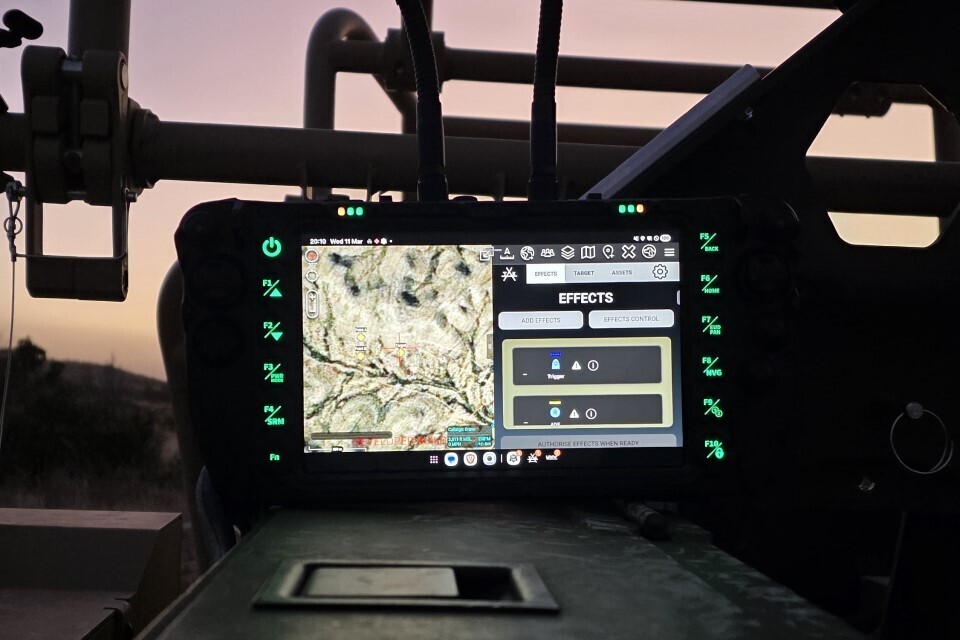
Image: The AIM user interface being used during Dstl trials in March 2026 (image credit: INVERGEX)
British defence scientists have developed a new digital communications standard designed to dramatically cut the time between detecting a threat and engaging it, potentially transforming how the UK military operates across networked, multi-domain battlefields.
The Defence Science and Technology Laboratory (Dstl) has created Assured Intent Messaging (AIM), a government-owned standard that enables sensors, uncrewed systems, targeting tools and missiles to exchange instructions through a common digital language. According to Dstl, the system underwent its first live operational trial in Texas in March 2026.
During the exercise, a single operator simultaneously controlled multiple in-service and experimental platforms, including sensors, uncrewed aerial vehicles, target-designation tools and ground-launched missiles. The connected devices communicated directly through AIM’s standardised messaging protocol, marking the first real-world demonstration of the language in a networked find-and-strike environment. Ten industry supplier teams participated in the trial, and Dstl confirmed AIM has proven viable as a minimum product. The standard is set for official publication in mid-May and open release to industry.
Why Interoperability Has Been a Problem
Modern military operations deploy hardware from dozens of manufacturers simultaneously. Getting those systems to communicate accurately and quickly has long been a bottleneck, one that costs commanders time and introduces risk at the worst possible moments. AIM directly addresses that gap. By giving all platforms a shared messaging framework owned by the government rather than any single supplier, the standard removes proprietary barriers and allows faster coordination across the battlespace.
A Dstl technical team member explained the operational rationale: “Commanders have multiple technologies in the battlespace, and it’s vital they work together quickly and efficiently. This universal messaging system helps harmonise communication between different systems, so decisions can be turned into action much faster.”
Designed for Degraded Environments
Disrupted and low-bandwidth communications are increasingly common on contested battlefields, and older systems struggle to function reliably under those conditions. AIM uses deliberately small message packets, making transmissions viable over constrained networks. The system also adopts a publish-and-subscribe architecture, similar to Internet of Things (IoT) protocols, ensuring messages reach only the systems that require them. That approach reduces network congestion and improves overall resilience. The standard also eliminates format-conversion errors, a dangerous failure point during time-critical targeting operations.
Open Architecture, Broader Competition
AIM’s government ownership carries broader strategic significance. Unlike proprietary solutions that lock the military into a single supplier’s ecosystem, the open standard invites any company to build compatible systems, widening competition, lowering costs and reducing procurement risk over time.
AIM complements Dstl’s existing SAPIENT standard for networked sensor systems. Together, the two standards form an expanding framework for connected, adaptable military capability. As uncrewed systems and autonomous platforms take on greater roles across NATO militaries, a shared messaging language capable of linking them becomes a foundational capability rather than a technical convenience.
Source: UK MoD Press Release