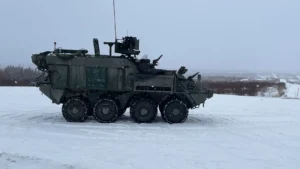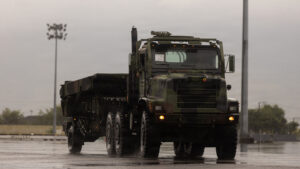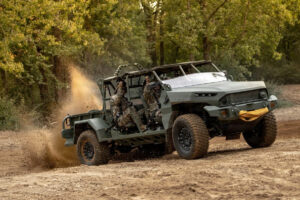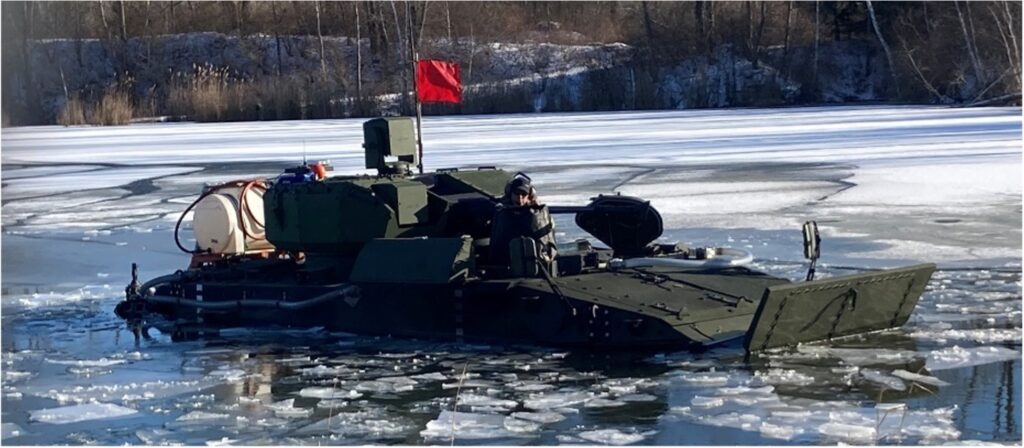
The ARV-30mm goes through contractor snow-and-cold-weather testing in December 2025 in Ontario, Canada. Image: GDLS
General Dynamics Land Systems moves into pre-production phase as the ARV competition enters a critical new stage.
General Dynamics Land Systems (GDLS) has secured a $450-million agreement from the U.S. Marine Corps to advance development of the Advanced Reconnaissance Vehicle (ARV), the company announced.
The contract covers the Pre-Production Development (PPD) phase, a pivotal step that brings the programme closer to fielding a next-generation reconnaissance capability for the Corps.
What the Contract Covers
Under the PPD agreement, GDLS will validate the vehicle’s final design and construct multiple vehicles spanning a subsection of the expected ARV family of variants. U.S. Government test and evaluation activities will follow.
The ARV programme aims to deliver a family of variants, suggesting a modular, scalable platform that could fulfil multiple battlefield roles beyond basic reconnaissance.
Programme Maturity
GDLS says its ARV prototype has undergone extensive testing during earlier competition phases. Keith Barclay, Vice President and General Manager of U.S. Operations at GDLS, expressed confidence in the platform’s readiness.
“Our ARV prototype has been thoroughly tested throughout the previous phases,” Barclay said. “We are confident in its ability to meet and exceed the requirements of the Marine Corps.”
He described the vehicle as a “transformational capability”, pointing to a step change from legacy reconnaissance platforms currently in service.
Strategic Context
The ARV programme forms part of the Marine Corps’ broader Force Design 2030 modernisation effort. That initiative reshapes the Corps into a leaner, more lethal force optimised for distributed maritime operations, particularly in contested island and littoral environments in the Indo-Pacific.
Reconnaissance vehicles are central to that vision. The ARV is intended to provide Marine units with organic, survivable intelligence-gathering at the tactical edge, reducing dependence on higher-echelon assets in degraded communications environments.
The decision to develop a family of variants also reflects lessons from modern conflicts. Commanders increasingly demand platforms that can be adapted quickly across roles including reconnaissance, command, electronic warfare, and direct fire support, without requiring entirely separate vehicle fleets.
Industry Significance
For GDLS, the award reinforces its position as a leading supplier to the U.S. military’s ground vehicle programmes. The Michigan-based company already produces the Abrams main battle tank and Stryker armoured vehicle family, giving it deep institutional knowledge of large-scale U.S. Army and Marine Corps procurement.
A successful ARV programme could generate significant follow-on production contracts. If the Marine Corps fields the vehicle across multiple variants and in meaningful numbers, the long-term value of the programme would far exceed the current PPD award.
What Comes Next
The PPD phase will determine whether GDLS’s design advances to full production. Government testers will assess performance, reliability, and suitability across operational conditions before any production decision.
No timeline for the conclusion of the PPD phase or a production award has been publicly announced. A competing vendor may also still be in contention, depending on the structure of the ARV competition, though GDLS has not disclosed details of the competitive landscape at this stage.