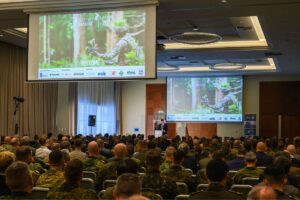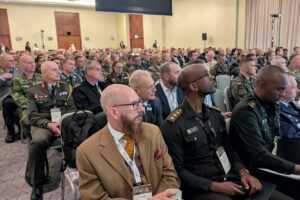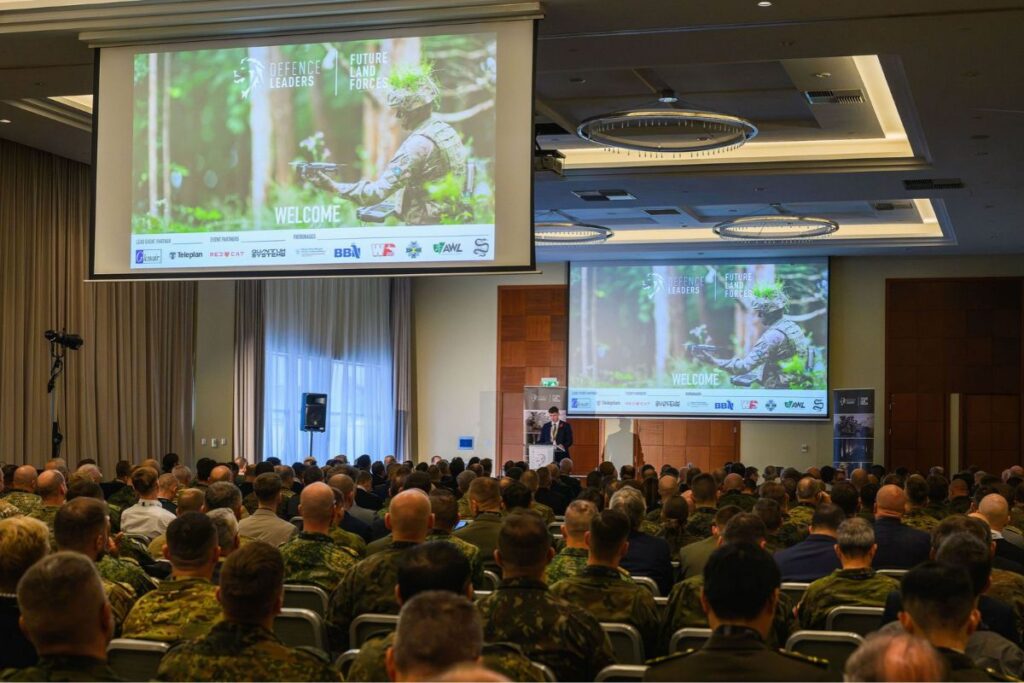
Defence Leaders’ Future Land Forces 2026 conference has come to an end, but what a ride it’s been.
We began the last day as we finished the last one, with presentations split between four separate streams. In one theatre there was a briefing on how Ukraine is integrating uncrewed systems at the brigade level.
Uncrewed aerial systems (UAS) have evolved from secondary assets into the fundamental structural backbone of tactical units, delegates heard.
Soon, the primary metric of combat effectiveness will be a unit’s ability to retrofit its operational logic around continuous aerial presence and rapid, decentralized strike capabilities. This transition is the prerequisite for the return of effective mechanized manoeuvre.
We were also told that the speed of technological change renders centralized training close to obsolete: an instructor’s knowledge expires within six months. Battlefield training is what counts for new recruits, and brigades now process 4,000 to 5,000 drones per month.
The speaker described the 24-hour observation drone carousel: transparency on the battlefield is now a requirement, not a luxury, so every company must maintain at least one continuous 24-hour carousel of surveillance drones.
This capability is the only guaranteed method for securing a given area, and achieving this requires local infrastructure for battery rotation, in-the-field workshops, and high-frequency pilot rotations (every 1-2 weeks) to manage the cognitive load and mitigate the high risks of movement between positions.
Once targets are located, they are watched continuously until they are engaged in a “find and hold” approach. The speaker noted: “It is much easier to track until you kill it, than to find it again.”
Delegates heard how time is a more valuable resource than hardware. Traditional drone launch points 10-12km (6-7 miles) from target result in engagement delays of 10-12 minutes.
By moving strike offsets to within a kilometre of the area of interest, the engagement window drops to 1-3 minutes. This “strike-by-pattern” approach ensures that detected targets are destroyed before they can reposition or take cover.
The speaker also talked about the rise of drone-on-drone warfare: the current dominance of munition-dropping drones (80% of current activity) is shifting. Future success depends on anti-drone operations: prioritising the destruction of enemy pilots and intercepting enemy UAS.
As the speaker bluntly put it: “The best air defence is a dead enemy pilot.”
Success also depends on electronic warfare (EW) integration: EW authority must be elevated to the deputy commander level at every echelon to ensure targeting projects remain viable in contested environments.
The speaker said uncrewed ground vehicle (UGV) integration was ongoing in the fields of logistics, mining, and medevac, reducing infantry involvement in these areas. Looking ahead, effective mechanized manoeuvre will only be enabled by established UAS dominance.
However, predictions indicate Russian forces will likely adapt to these tactics fairly swiftly, meaning the window for strategic advantage is narrow.
Another briefing looked at the training transformation of the 2e REI — more widely known as the French Foreign Legion.
The speaker said that as demonstrated by Ukraine, the drone revolution represents a shift in warfare comparable to the introduction of gunpowder or the machine gun, fundamentally altering the tactical environment.
He identified four primary shifts in the modern combat environment driven by UAS proliferation: constant surveillance with any identified position immediately targeted; lethality and speed, with the threat of FPV drones and indirect fire requiring near-instantaneous reaction; fortification with survival predicated to a return to intensive trench-digging and physical protection; and isolation, requiring infantry to perform tasks traditionally reserved for engineers (mining, bridging, trenching), as well as front-line casualty care.
Following mentorship of Ukrainian forces in Poland in 2025, a rapid transformation of training modules was enacted to address these pressures.
A “Tactical Pulse” principle was developed: maintaining dispersion to avoid strikes, then rapidly concentrating at the moment of breach. Training of infantry was adapted into high-intensity 3-5 day modules focused on trench warfare, drone marksmanship and autonomous group defence. And tactical combat casualty care (TCCC) training was increased from roughly ten hours to between 30 and 50 hours per recruit, mirroring the Ukrainian model of survival under high-attrition conditions.
The transformation has moved from initial testing in April 2026 by French and Belgian companies to full Implementation during August, with the rollout of five-day transformation modules to entire companies.
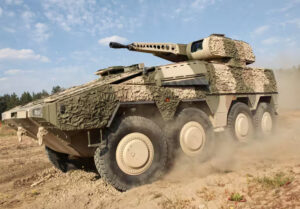
Consolidation is ongoing, and next steps include addressing the armoured personnel carrier (APC) dilemma. While APCs provide mobility, they are high-value targets for drones: a new balance is required between heavy APCs and light, dispersed mobility.
Other lines of effort include AI and innovation: development of internal ‘data drone’ communication systems and AI-based recognition software to mitigate the signature of traditional radio links.
Solutions are also being sought to civilian and peacetime military regulations regarding use of explosives and live-fire drone training, a significant hurdle to the pace of transformation.
In another theatre there was an analysis of the Russian air campaign over Ukraine, which has transitioned from an improvised ‘shock and awe’ failure into a sustained, industrial-scale attrition strategy.
This shift is characterized by a move away from legacy strategic aviation toward a rapid-iteration drone ecosystem underpinned by a transnational supply chain.
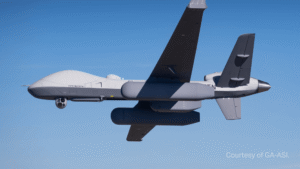
Delegates were told that the Russian long-range aviation fleet is a finite, degrading resource. In response, Moscow has pivoted to a high-volume, precision-strike doctrine using “missile-drone hybrids” and jet-powered UAS.
Russia’s long-range aviation is constrained by legacy airframes and production limitations. Only the Tu-160 remains in active production, while the Tu-22 and Tu-95 fleets suffer from declining readiness (estimated at 60% pre-war) and non-combat accidents. These platforms are increasingly relegated to standoff roles.
In contrast, its drone campaign is no longer a stopgap, but a sophisticated industrial pillar, with the Yelabuga factory in the Republic of Tatarstan,about 600 miles east of Moscow, among its primary hubs, reportedly employing 10-12,000 North Korean workers alongside foreign recruits from Africa and Asia.
Rapid development cycles have integrated mesh networking, 4G connectivity, Raspberry Pi controllers, and experimentation with Starlink terminals.
Drones have been transitioning from the piston-engined Geran-2 to jet-powered variants (Geran-4 and Geran-5) to increase speed and manoeuvrability, alongside jet-powered decoys designed to deplete interceptor reserves. This last tactic represents a significant threat to Ukrainian interceptor economics.
Iran has provided the foundational base technology and initial airframe designs; China supplies critical components, specifically jet engines that Russia is currently unable to mass-produce domestically, and North Korea acts as both labour source and a primary provider of ballistic munitions, with observed improvements in missile quality over time.
Russia is maintaining a consistent operational tempo, deploying 500 to 600 drones monthly to maintain posture pressure. The strategy has shifted from general psychological warfare to precise targeting of electricity grids and export infrastructure.
Its deep strike campaign reflects an improved proficiency in mission planning and damage assessment. Weaknesses include engine dependency: despite volume increases, Russia remains reliant on Chinese jet engines.
Fleet attrition is another issue. The lack of housing shelters for the long-range aviation fleet and the accumulation of flight hours on ageing airframes has limited Russian strategic lift capabilities.
After lunch, the conference switched back into twin plenary sessions before its close. One session focused on NATO’s Lessons Learned Centre.
Delegates were told that previously, while NATO had focused heavily on shortening the ‘kill chain’of sense, decide, act, the current strategic environment demands equal focus on the learning chain: the time between experiencing a problem, identifying the necessary change, and implementing it.
NATO Lessons Learned 3.0 is the shift from retrospective analysis to real-time ‘Audacious Learning’ leveraging AI and a culture of default transparency to turn battlefield experience into immediate operational advantage.
It talked about operationalising a new SABRE concept (Swift Adaptation through Battlefield Reporting of Experience). Currently in the experimental phase and tested during Exercises Steadfast Duel and Steadfast Defender, SABRE aims to support commanders while operations are underway.
Another briefing focused on the European Union Military Assistance Mission (EUMAM) Ukraine, which serves as the primary multinational training effort for the Ukrainian Armed Forces (UAF), providing approximately 80% of total assistance.
Established in October 2022, the mission operates under a shared command between Poland (CAT-C) and Germany (Special Training Command).
Nearly 100,000 Ukrainian personnel have been trained since the invasion began. The current mandate is secured through November 2026, with an expected strategic extension to 2028. EU and member state assistance is valued at approximately $227 million as of October 2026.
A fundamental shift in the training model is underway. The offer-based collective training of 2023-24 is being replaced by a demand-based model tailored to specific UAF requirements.
The 2026–2027 programme prioritizes specialised technical training, leadership development, maintenance, cyber warfare, and instructor preparation. Mission efficacy is maintained through a continuous feedback loop integrating instructor reports, student feedback, and internal inspections to adapt training to frontline realities.
These final presentations were an engaging and fitting end to a content-rich week in Warsaw. Defence Leaders thanks everyone who has participated at FLF 2026: we look forward to welcoming you back next year!