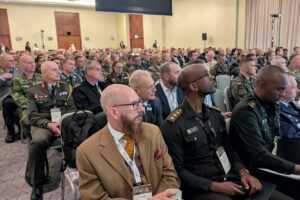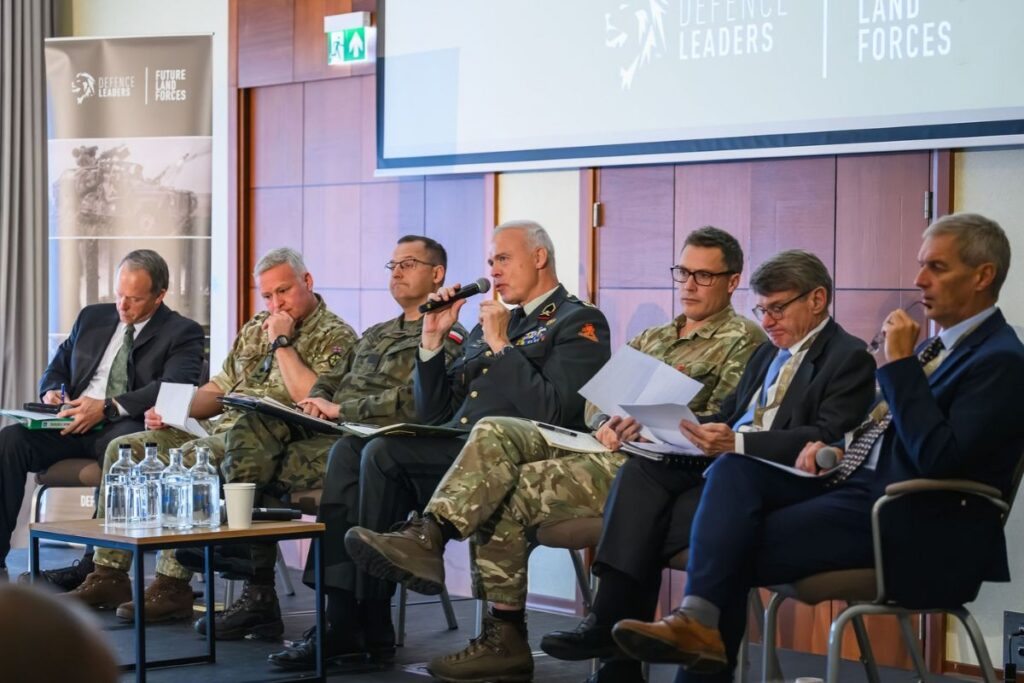
Information has been flowing in streams on Day Two of this year’s Future Land Forces conference (FLF 2026), with delegates free to pick and choose presentations in four separate theatres.
One early brief tackled the strategic and technical frameworks for European theatre NATO air and missile defence (AMD).
As the speaker framed it: “Air missile defence is about managing scarcity. We have to make difficult decisions about what we are going to defend.”
And he later added during Q&A: “I don’t foresee a time when we’re ever going to be managing abundance, unfortunately.”
The fundamental challenge is that resources are insufficient to defend all assets. Command must navigate a two-stage prioritisation process taking in both national interests and Alliance requirements.
The speaker also highlighted technical realities and what he termed the ‘Bubble’ myth. AMD happens in a three-dimensional space defined by minimum/maximum engagement altitudes and ranges, and few radars offer true 360-degree ground-to-space coverage.
The speaker explained: “‘Bubble’ is not a helpful or accurate term. For the most part we are talking about point defence. With a Patriot I can defend something the size of an airbase… if I need to defend a city, I’m going to need a bunch of them… When we say something is defended, the question is defended against what.”
He also tackled interoperability challenges: the complexity of NATO’s architecture stems from decades of disparate procurement. The audience heard about the difficulties presented by ‘swivel-chair syndrome’ — describing what operators had to do when trying to manage incompatible systems.
And there was also a more nuanced version, where “we get track data, but I cannot pass that data because of latency… we are in the milliseconds business: when the closing speed is Mach 9, milliseconds matter.”
A later briefing described the Ukrainian Phalanx operational model developed by the Ukrainian 1st and 475th Assault Regiments to counter the realities of high-intensity warfare on a transparent battlefield.
It involves, in short, decentralizing deep-strike capabilities and integrating multi-domain operations (MDO) directly at the tactical level.
Traditional mechanized mass has become obsolete due to total battlefield transparency, delegates heard. Reconnaissance drones and automated spectrum analysis have created a “kill zone” extending 30km from the line of contact, making top-down command structures too slow for effective fire support.
The new model replaces vertical bureaucracy with horizontal regimental integration, granting ground commanders organic reach at ranges up to 150km (90 miles) and beyond.
The model integrates four functional domains into a single horizontal command and control system. Its ground component is designed to preserve infantry life. Ground assaults are the final step, occurring only after an objective is isolated and disorganized.
Medium and deep strikes with massed, low-cost UAS allows regiments to strike into enemy rear areas, severing front lines from fuel, personnel and ammunition resupply.
Multi-sensor intelligence is fed into an all-source system aggregating optical/radar satellite imagery, OSINT, and transportation data.
And operational analysis is handled by a ‘digital brain’ managed by joint analyst groups. It converts raw data into immediate fire missions, creating a constant feedback loop between flight telemetry and the operational picture.
This year in the Zaporizhzhia region, delegates heard how rather than destroying bridges, the units damaged roadways to create artificial traffic jams. They then systematically targeted fuel tankers and ammunition pumps within those bottlenecks.
UAS were launched in groups of three to eight. Lead drones were used to draw fire and reveal air defence positions for follow-up strikes.
In the first half of 2026, the 1st and 475th Regiments liberated over 80 square kilometres in the Zaporizhzhia region. The system successfully paralyzed enemy logistics, reducing Russian fuel supplies to critical levels where entire formations received only as much diesel as a single Ukrainian regiment.
Lessons for capability development centred on the value of regimental autonomy: centralised command can be a liability in high-transparency environments, where “data life is measured in minutes.”
Horizontal cooperation achieved success by two regiments cooperating, merging intelligence feeds, strike assets, and targets. Combat effectiveness is dependent on the ability to disrupt the enemy’s operational depth before the first soldier leaves an armored carrier.
Sticking with Ukraine, a separate brief outlined how its 3rd Army Corps is transitioning from human-centric to autonomous-integrated operations, treating uncrewed ground vehicles (UGVs) and UAS as fundamental mission components.
Outlining an operational shift within a sector covering more than 150km (90 miles) of the front line, the Corps has set a strategic target to replace 30% of its infantry with UGVs by the end of 2026.
Robots are taking over the most hazardous tasks: not just mine clearance, logistics, and casualty evacuation (CASEVAC), but also direct assault.
There’s decentralisation of technical adaptation, with each regiment operating its own “IT workshop” where engineers and soldiers modify and solder systems in real-time to meet the specific requirements of an upcoming operation.
UGVs are integrated into the operation before the planning phase begins, and it’s understood that there is no ‘universal’ UGV: success depends on modifying hardware for specific mission parameters (for example, terrain or EW environment).
During recent operations covering about 270 sq km (100sq m), the integrated approach yielded significant results: over 340 tons of cargo delivered via UGV; 350+ targets engaged using FPVs and specialized UGV platforms; and autonomous assaults
Operational firsts included successful prisoner-of-war (POW) captures and self-detonating ‘Bullspike’ missions (UGVs equipped with grenade launchers) conducted without direct infantry presence.
The speaker highlighted three fundamental requirements for modern autonomous warfare: UGVs must be a primary part of the mission build, not perceived as an ‘app’ or an add-on; systems must be adapted to match the specific mission; and UGVs achieve maximum lethality only when synchronized with infantry, artillery, and air defence.
A different briefing in another theatre included recounted the evolution of Israeli military connectivity and command and control (C2) infrastructure in the conflicts in Gaza and later Lebanon in the wake of the October 7, 2023.
The speaker outlined the transition from emergency restoration of communication sites to the deployment of agile, resilient, and decoupled systems.
C2 decoupling — the strategic separation of communication antennas/satellite terminals from command vehicles and/or headquarters — was required to mitigate the risk of enemy targeting: visible satellite equipment signaled the presence of high-value commanders.
Another challenge highlighted was the “Information Paradox,” where increased bandwidth leads to cognitive overload. The objective is to move from providing commanders from all data to just salient information via centralised databases and intelligent filtering.
The speaker also described how changes in environments demanded different approaches. In Lebanon, its green-field character necessitated establishing satellite communication infrastructure in areas with zero existing coverage, high topographic disparity, and limited HF/UHF communications. ‘Stealth hubs’ were disguised within Warrior tanks to maintain connectivity without presenting a target.
By contrast, in the Gaza tunnel networks, standard radio waves failed. The solution involved mesh networks, where soldiers or nodes were placed at corners and stairs to maintain a relay chain from the entrance to the deep interior.
Before the conflict, satellite communication had been reserved for special units. The exigencies of the war led to the rapid deployment of satcom terminals across nearly every C2 platform.
Elsewhere, delegates in one theatre enjoyed a brief on how drones had altered field artillery tactics. Essentially, they have transitioned from a doctrine of massed fires to one defined by radical dispersion, precision, and a collapsed sensor-to-shooter loop.
The war in Ukraine continues to serve as the primary laboratory for these shifts, highlighting the obsolescence of traditional battery combat orders in the face of battlefield transparency.
Traditional battery or platoon formations have been replaced by dispersed, autonomous gun operations, while real-time reconnaissance via drones and satellite imagery has reduced response times to as little as one minute.
The proliferation of tactical drones allows both sides to observe individual soldiers within a 10 to 20 kilometre (6-12 mile) radius of the frontline. This transparency has often necessitated a move toward “shoot and scoot” mobility and advanced multispectral camouflage.
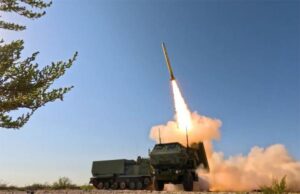
While precision munitions like GMLRS have to some extent been game-changers, their effectiveness can be challenged by sophisticated EW interference: sometimes, conventional munitions remain a better option.
Effective logistics for future conflict depend on interoperability: the speaker advocated 155mm projectile and 227mm rocket systems as foundational standards for European and NATO forces to ensure resilient supply chains.
In terms of doctrinal evolution, militaries must shift from a reliance on massed fire to “continuous, accurate, and targeted fires.” Speed and precision are the new metrics of artillery effectiveness.
Also, the integration of Starlink and digital C2 applications such as Delta represent a departure from traditional closed military communication systems. Access to the internet, once dismissed by military traditionalists, has become a critical operational requirement for modern command and control.
Another briefing addressed manoeuvre considerations in the Arctic and High North. While northern terrain favours the defender, delegates heard, surprise attacks can penetrate about 150 kilometres (90 miles) within 48 hours, and can then be very hard to regain.
Geography limits avenues of approach to one or two corridors, allowing the enemy to concentrate sensors and fire. Relying on heavy forces could lead to “inescapable kill chain attrition” pitting Western technology against Russian mass — a scenario that favors Russian fire-centric doctrine.
That said, the terrain lends itself to weaponising environmental friction, provided that forces train enough to achieve what was dubbed “Arctic mastery.” This “Ranger Solution” would see light, signature-managed forces infiltrating tactical gaps, allowing combat power to bypass frontal kill zones and strike High-Payoff Targets (HPTs) in the enemy’s rear.
The Arctic environment provides unique opportunities to degrade modern sensor networks (UAS, thermal, and ground-based). Battery depletion in extreme cold, operator fatigue, and reduced drone flight times create windows for infiltration that do not exist in temperate climates.
HPTs naturally gravitate toward “high environmental efficiency” zones (roads and sheltered buildup areas). By manoeuvring through low-efficiency zones (off-road and rocky terrain), Ranger forces force the enemy to either accept suboptimal defensive positions or pursue the threat into terrain where the defender holds a superior competency.
The speaker described this Arctic Mastery as a binary threshold: “If you are below that threshold, your efforts go towards surviving; if you are above, you are thriving.”
In other words, Arctic competence means forces can focus entirely on inflicting casualties. And the Arctic climate acts as a force multiplier that performs much of the ‘killing’ when the enemy is driven out of sheltered areas.
A panel discussion on AI towards the end of the day in another theatre also produced some striking opinions. Here are a few of the views voiced:
- “If you don’t change, you will get outpaced, and people will die.”
- “We have got to do it [introduce AI] in a legal and ethical way, but we have also got to do it at speed.”
- This isn’t a three-year conversation: we have to adapt, we have to be ready for Day Zero. If we are having this conversation in three years, we have got a big problem… we should all probably start learning Russian.”
- “For Ukraine, the biggest risk is not taking risks.”
This was an intriguing way to end a day full of useful discussions and insights. Our final day will see another morning in streams before we come together for closing plenary sessions. We are sure tomorrow will prove equally rewarding!