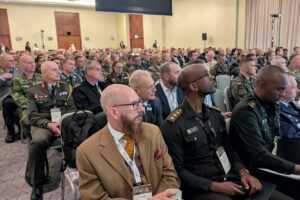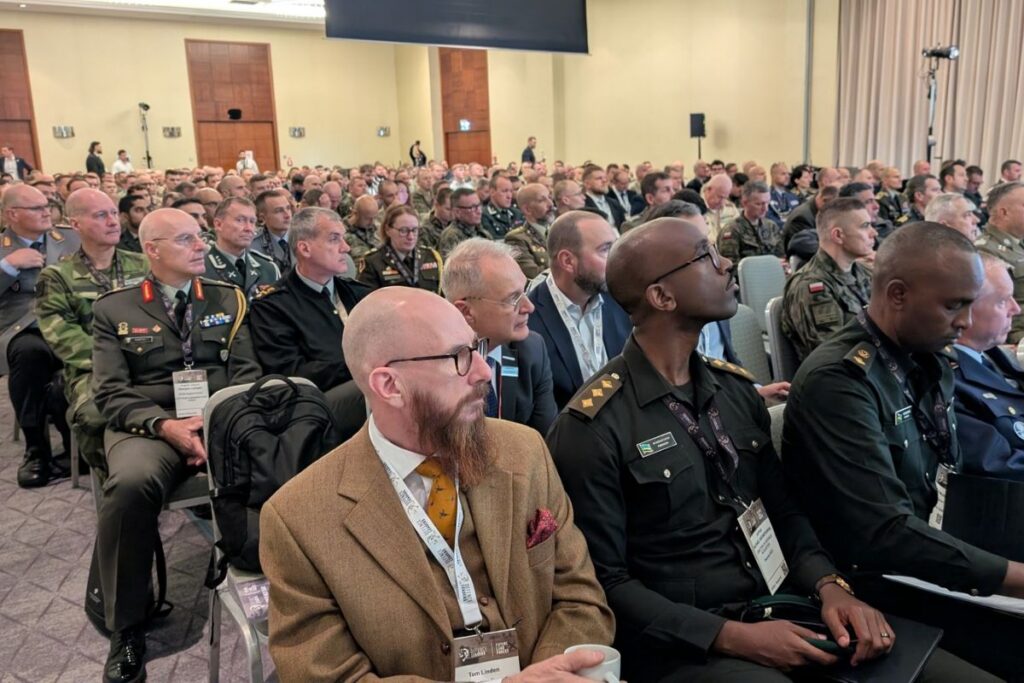
The opening day of Future Land Forces 2026 laid out both the threats facing today’s militaries, and how our armed forces are rising to meet those challenges.
The day started with twin plenary sessions set out across two separate theatres. In one early session, an overview was provided on the host nation’s security environment and its response.
Poland’s defence posture has shifted from transformation to active readiness, driven by an unpredictable security environment and Russia’s ongoing hybrid war against the West.
While Poland anticipates a permanent U.S. military presence, the operational focus has pivoted toward European self-reliance in intelligence, surveillance, and deep precision strike capabilities.
Russia was characterized as being in a state of war with the West, deliberately operating below the NATO Article 5 threshold to force national rather than collective responses to hybrid threats.
Delegates were told there was a critical requirement for European nations to rebuild independent defence capabilities, specifically reducing reliance on U.S. intelligence, surveillance, and deep precision strike assets.
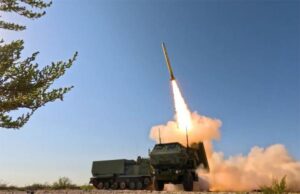
Poland has identified three specific pillars for immediate investment and development. Firstly, deep precision strike: this includes participation in the European Long-Range Strike Approach (ELSA) programme and alignment with NATO defence plans. Its focus extends beyond ballistic missiles to include hypersonic weapons and long-range drones.
Doctrine is key: emphasis is placed on the decision-making process and intelligence access, rather than just the kinetic effector.
The second pillar is autonomous and counter-uncrewed aerial system (C-UAS) capabilities. This takes the form of “Model 44,” a new tactical structure integrating UAS and counter-UAS subunits into every battalion.
In total about PLN 15 billion ($3.8 billion) has been allotted to the “SAN” counter-UAS system to help secure borders with Belarus, Ukraine, and Russia.
The third key pillar is Artificial Intelligence (AI), including implementing its new AIRON platform into its classified and unclassified networks; and testing its new AIRON Vision sensor and image analysis software.
The speaker concluded: “NATO is a defensive alliance. We are not attacking anybody: there are no plans to attack anybody. However, if we are attacked, we will use all our means to respond.”
Another presentation looked at the British Army’s transformation with regard to combined arms manoeuvre under the 20/40/40 model.
The British Army is undergoing a fundamental shift in doctrine and force structure, driven by the transparency of the contemporary battlefield in Ukraine and the rapid adaptation of Russia’s armed forces.
The speaker’s central thesis was that adaptation itself was now a core warfighting capability.
He commented: “We’ve got to learn from Ukraine, without simply learning to fight the war in Ukraine… The Russian army we’re studying today… will not resemble the force we will eventually fight.”
And he posed the question: “How do we move urgently without locking ourselves into an answer that quickly becomes obsolete?”
“Our central vision is this: transformation is not simply new equipment or new tactics. It’s an operationalized approach to continuously studying our adversary, to sharpen our decision-making and build a coherent fighting system in which we keep adapting as we learn more.”
He added that the transition from the Warrior infantry fighting vehicle (IFV) to a new mix of platforms marked a break in the armoured division construct that had existed for 50 years.
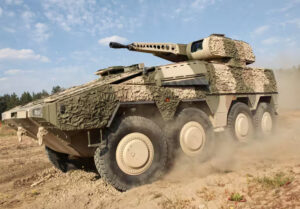
The division will now centre on Ajax, Boxer, and Challenger 3, supported by modernised fires and data. Platforms are no longer the primary focus: they are vehicles for projecting kinetic and non-kinetic effects further out.
The force is transitioning to General Roly Walker’s 20-40-40 vision: 20% traditional combat power, 40% semi-attritable uncrewed systems, and 40% attritable one-way effectors and munitions.
The speaker described the ideal new “recce strike” methodology: identify high-payoff targets; connect resilient networks; collapse decision-time; exploit the strike window; and then reset and repeat.
He defined its biggest challenge as integrating sensing, decision-making, and effects under contested conditions.
He said new doctrine should be viewed as a “51% hypothesis” to be tested in adversarial conditions, exposed for its weaknesses, and rapidly iterated.
Manoeuvre is not dead, delegates heard, but it must be enabled by setting conditions through recce-strike to survive inside the sensor-effector forest.
Another fascinating brief was delivered by a Ukrainian presenter, who explained how AI was being integrated into its armed forces.
The briefing focused on shifting AI from a laboratory concept to a battlefield reality, prioritizing the acceleration of the sensor-to-shooter loop to save soldiers’ lives and defeat adversaries through superior data processing.
“The mission is to turn AI into battlefield advantage,” they said. “Whoever closes the kill chain fastest, wins…The goal is to stay several steps ahead of the enemy.”
The speaker described the race to use AI as a “war of operating systems” and observed that hardware was just the start: “Software is the brain; hardware is the hands.”
Ukraine’s flagship AI system is dubbed SPECTR, described as the “brain” for a diverse ecosystem of defence software. It is designed to analyze data, find patterns, and suggest actions across the entire defence infrastructure.
They said AI can help with four key tasks: it can analyse data faster to speed decision-making; it can be integrated onto weapon systems to improve their effectiveness; it can be a bureaucracy-killer; and it can speed up research and development (R&D) cycles.
It’s available in a cloud-based version for situational awareness and an air-gapped version for processing classified data without internet connectivity.
The system provides reasoning for every recommendation, ensuring the battlefield commander remains the final authority and stays accountable for the execution of AI-suggested plans.
Ukraine maintains full control over its architecture, models, and data, ensuring technical independence.
The speaker also pointed out SPECTR was a one-window, single-input-based system: “If the solution is difficult to use, then it will not be used on the front line.”
And they insisted AI was never being used as a default: “We do not use AI for the sake of AI… Every project that we are working on comes from the requests of battlefield commanders.”
All the same, over 200 companies are currently working on defence AI in Ukraine, with more than 300 solutions registered and 70+ major systems already in active use by the military.
Video footage was shown of AI-enhanced interceptors targeting Shahed drones: the speaker reported a 95% success rate in neutralizing these threats. Another clip showed an AI-guided turret targeting and defeating FPV drones.
They said AI could be viewed as a kind of deterrence technology, not limited to traditional superpowers. They said “democracies must be protected” and even countries not currently at war needed to develop their capabilities to stay protected.
As the speaker noted: “You cannot create a fully working system in a laboratory.” So the presentation concluded with a call to democratic allies to leverage Ukraine’s real combat data — the largest such dataset in the world — to help build a decisive collective Allied technological advantage.
In the first afternoon the conference divided further into four streams. In one theatre, the topic was the transition of the British Army’s experimentation battalion into a specialized combat formation, focusing on the doctrinal shift toward ‘Near-Surface Operations.’
Key takeaways included that current Counter-UAS (C-UAS) efforts are over-indexed on ‘goal-line defence’ — point protection and low-level electronic warfare. The strategic requirement is to move from passive defense to attempted control of the air at the tactical level.
The battalion experimented with an offensive C-UAS Platoon, working on the theory that sitting back to defend rear areas is insufficient. Dominance is only achieved by targeting the enemy’s UAS supply chain, command nodes, and active emitters (radars/EW).
The battalion is now moving out of its ‘beta’ experimentation phase to potentially form the core of a dedicated Uncrewed Systems Force (USF) Brigade.
The presentation highlighted training system friction: Project Convergence (Capstone 6 earlier this year) revealed that current training instrumentation is fundamentally biased toward 20th-century direct-fire manoeuvre.
It fails to account for beyond-line-of-sight (BLOS) interactions between autonomous platforms, and has a shortage/absence of human observers in machine-to-machine engagements.
The audience heard that effective UAS integration requires payload agnosticism, building units around capability, not specific hardware that will be obsolete in months, solving regulatory issues where safety and flight regulations prevent realistic large-scale autonomous training, and bringing testing and capability development down to the unit level to maintain agility.
A separate presentation from Norway addressed recent experiments by its defence research establishment on uncrewed ground vehicles (UGVs), taking in teaming with UAS and integrating remote weapons stations (RWS).
To prevent vehicles from getting stuck due to the limited perspective of single-camera feeds, the team is developing a 3D version that fuses onboard sensor data into a bird’s-eye perspective for the operator.
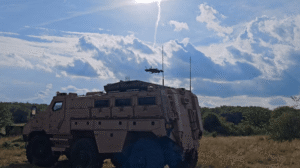
And when it came to weapon station integration and C-UAS capabilities, the presenter detailed a best of both worlds approach to drone detection by fusing radar and optical sensors.
Radar provides distance but lacks directional precision: cameras provide precise direction but lack depth. Combining them enables accurate tracking.
In terms of clutter management, neural networks are being utilized to separate drones from complex backgrounds like vegetation, sea, and sky. Testing with Kongsberg weapon stations demonstrated successful tracking and engagement of UAS targets.
Joint field experiments between Swedish and Norwegian UGVs had seen a 5G local network ‘bubble’ deployed to manage eight uncrewed vehicles. This proved highly effective, exceeding expectations for cross-nation integration.
Interoperability and standards work has focused on finalizing standards to ensure any controller can operate any UGV, via NATO STANAG 4818, which focuses on low-level control, including waypoints and secure paths, and STANAG 4817, the high-level, multi-domain standard for collaborative tasking and distributing tasks.
Towards the end of the day another presentation from a Ukrainian military expert offered drone warfare lessons. Among the chief insights were that modern high-intensity conflict was defined by the suppression of electronic warfare (EW) and air defences to enable effective precision strikes.
Tactical superiority is less about mass, and more the speed of the adaptation cycle. As the speaker put it: “What was effective a month ago may not work today.”
Also, while there is merit in the radical decentralisation of command, coordination with neighboring units up to a Corps level ensures alignment with broader strategic priorities.
The evolution of uncrewed systems is moving at a pace that renders traditional procurement obsolete. New battlefield tools must be delivered and iterated in cycles no longer than two months: combat tempo is the only relevant metric for institutional success, and direct feedback from end-users is essential.
The adversary’s EW systems have been adapting rapidly, and maintaining an edge requires constant modernisation of control frequencies and signal hopping.
The speaker also spoke about the utility of integrated strike packages; effectiveness is maximized when combining diverse assets, using massed low-cost drones to thin enemy defences, followed by strikes with bigger, more expensive assets capable of inflicting heavier damage.
He gave examples of recent adaptations including UAS ISR scouts that had been turned into counter-air defence weapons by integrating FPV drones.
When surface-to-air (SAM) batteries fired at them, they revealed their positions: the UAS then launched an FPV drone to attack and destroy the SAM battery. This technique had been extensively and effectively used to clear the path for deep strikes during the Kursk offensive, delegates were told.
As should be clear from all the above — just a small sample of the content on offer — Day #1 has been packed to the brim with real-world experience and insights. Bring on Day Two!