Day Two of Global Defence Aviation 2025 (GDA25) has dedicated to streams, with delegates free to wander between four theatres, each with their own separate focus.
The themes assigned to each theatre were, respectively: Defence helicopters; Modernisation and maintenance; Operational effects; and Uncrewed Air Systems.
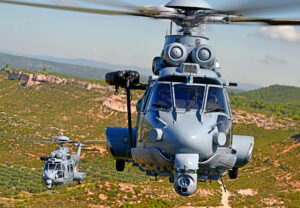
Never afraid to shy away from the big questions, one of the initial panels addressed a stark question: Do helicopters have a future against uncrewed aerial systems (UAS)?
Giving their thoughts and engaging in a frank back-and-forth with the assembled audience were representatives from the British Army, the French Navy, and the German Army.
Some particularly thorny questions were asked. Is manned-unmanned teaming (MUM-T) — aka crewed-uncrewed teaming (CUC-T) — a genuine force multiplier, or just a desperate attempt by rotary-wing industry to stay in the game?
What’s the value of keeping a “human in the loop” if your helicopter-launched air-launched effect (ALE) is prosecuting a target that’s beyond line-of-sight (BLOS) 20-25 miles away?
How do you defend a crewed helicopter platform against a fast, hard-to-spot FPV drone? How can we contemplate a fully uncrewed future when platforms’ technical failures can only be fixed by human intervention to effect repairs?
And how can one tell the difference between constructive failures on uncrewed systems to learn fast, as opposed to simply flogging a dead horse?
While no-one present pretended to have all the answers, the panel and audience alike had some interesting points of view. Germany’s armed forces are developing a use case where fully uncrewed systems could be sent into combat first to pave the way for crewed platforms later.
These crewed platforms could be relatively low-armed command nodes, but themselves twinned with a swarm of mission-specific drones. But heavy-lift tasks such as troop insertion were likely to remain the preserve of crewed platforms until at least 2050-2060.
By contrast, while the French Navy is already looking at fully automating some of its heavy-lift logistics tasks to a shorter timeframe, it sees the value in retaining crewed fighting platforms to retain the element of human unpredictability.
It was also suggested that embracing an uncrewed future might be a question of necessity rather than desirability, given the wider cultural trend of falling recruitment rates for militaries in Western nations.
And the British Army is looking at a range of counter-uncrewed aerial system (CUAS) measures for its own crewed rotary-wing platforms. Some of these are pod-based electronic warfare (EW) concepts linked to drone-spotting cameras.
But the idea was also flagged of launching first-person-view (FPV) drones from the crewed platform to counter FPV threats — in other words, fighting fire with fire. “All these tactical ideas are very much nascent,” admitted one panel-member. “These conferences are a great place to discuss these sorts of things.”
Sticking with drones and CUAS, there was an interesting presentation in one theatre on how the Turkish Air Force (TURAF) is using uncrewed systems for counter-terrorism operations and its future plans for UAS generally.
The audience heard how having lost an estimated 15,000 lives to acts of terror in recent decades, the introduction of uncrewed systems to offer persistent surveillance across Turkiye’s extensive landmass has been game-changing for its domestic security.
Precise targeted interventions “make terrorists feel as though they are being followed all the time” and help curtail their activities; drones have enabled TURAF to respond more rapidly and conduct 24-7 persistent ISR as required.
Domestically produced by globally deployed uncrewed systems such as the TB-2 are being navalised in the near future, while the Akinci drone is being given air-to-air strike capability to complement its existing air-to-ground weapons.
And the audience also heard an outline of TURAF’s future UAS plans; it envisions drones in at least equal numbers to its crewed platforms, and working collaboratively. Its Kizilelma system will have an operational ceiling of about 45,000 feet, three hours’ endurance, and be able to travel at high subsonic speeds, while the Anka 3 will marry stealth-level radar visibility with high payload capacity.
Later Robin Radar’s entertaining presentation married some genuinely amusing anecdotes with a wealth of information about its IRIS CUAS, which employs Doppler-effect sensing technology married with AI to distinguish between and identify different potential threats early and with high degrees of accuracy.
Elsewhere, delegates heard about the Royal Navy’s ongoing transition to a hybrid air wing; as recently mandated by the First Sea Lord, “uncrewed where possible, crewed where necessary.”
The aim is to field a high-low mix of capabilities with smaller numbers of crewed exquisite platforms, plus larger amounts of uncrewed systems to offer mass. But our speaker maintained: “The fight tomorrow will not be won by who has the most advanced drone, but by who uses it most effectively… the human factor will remain the deciding factor.”
He called for a wholescale shift away from unending piles of prescriptive doctrines and performance-based targets and platform-based training towards a culture that placed ultimate value on creative thinking and problem-solving instead.
Other notable insights offered through the course of the day included a debate about the tension between increasing sensors to optimise platform effectiveness on one hand, against the disbenefits of that approach on the other.
These downsides principally revolved around both the increased cognitive load on the pilots, and on a related note the increased processing and energy requirements to process that extra data, both of which also come with weight implications for airframes.
Making use of the old maxim that seeing is believing, Northrop Grumman’s excellent presentation on aircraft survivability included contrasting with-and-without video footage of missiles being fired from 5km away at a test target both with its CIRCM countermeasures system switched on, and with it switched off.
Needless to say, with the system off the missiles hit home, and fast; with it switched on, they spiralled away out of control within a few moments of launch.
There was an interesting presentation, too, on the European border security agency Frontex which made mention of its existing use of UAS for persistent surveillance in southern Europe and its future plans to test high-altitude systems next year; eventually it’s seeking to achieve comprehensive Europe-wide coverage.
Elsewhere delegates heard about the benefits joint procurement via NATO’s Support and Procurement Agency (NSPA) can bring, with a case study focusing on the MQ-9B UAS system.
Put simply, these include economies of scale; accelerated fielding; support through the whole lifecycle of platforms from acquisition to sustainment and common training and support; and ‘baked-in’ compatibility with fellow NATO nations.
As the speaker put it: “By the time we need it, it’s going to be too late, so that’s why interoperability has to be built in from the start.”
Industry presenter Skytrac provided compelling use-case scenarios for uncrewed systems having multi-network connectivity and provided real-life examples of where MUM-T operations weren’t just pie-in-the-sky hypothetical scenarios ten years out involving loyal wingman programmes, but were actually already happening today.
One example provided included Schiebel rotary-wing UAS providing MUM-T functionality to British HM Coastguard for maritime search and rescue, with drones being able to be first on the scene and relay video feeds and accurate positional data via Starlink and/or Iridium satellites, potentially even in areas where spoofing was affecting a stricken vessel’s GPS.
And in the uncrewed systems stream the day wrapped up with a highly informative presentation on the dangers of icing for UAS — principally affecting fixed-wing platforms, but to a lesser extent rotary-wing ones too.
Atmospheric in-flight icing, and its more extreme version, freezing rain, comes when supercooled water droplets in freezing-temperature clouds hit a platform’s surfaces and freeze instantly. While latitude and season-dependent, it’s an issue that’s to some extent year-round and global.
And it can lead to system failure and loss and limit operations if anti-freezing systems are not installed; propellers can become less efficient, severe vibrations can be induced, and air-speed and visual sensors can freeze over and stop working.
What’s worse, when airspeed sensors fail, they don’t read zero, they just freeze at their last functional reading, making detecting the failure tricker. Heating systems can mitigate these problems, but they are power-hungry… other solutions being investigated include in-flight antifreeze misting and even development of icephobic materials, though these are still at the experimental stage.
As ever, the myriad topics discussed throughout the course of day were as wide-ranging as they were fascinating… bring on Day Three!