It’s hard to believe Global Defence Aviation 2025 (GDA25) has already come to a close — but what a ride it’s been!
Day Three sustained the momentum of the last two days, the morning offering a choice of topics in two separate theatres before bringing everyone together for a final plenary session.
There was an insightful presentation on the continuing hard-fought battle in the skies over Ukraine between helicopters and drones, examining changes in tactics, techniques, and procedures (TTPs) and the adaptations the Ukrainian Air Force (UAF) has made in the course of the conflict.
There were a series of videos showing battlefield encounters, and conclusions that could be drawn. The Ukrainians are using a mix of commercial and military systems, some domestically developed, with direct links between tactical-level combatants and industry to accelerate development.
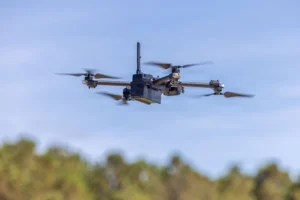
Russia’s drone activities have evolved over the course of the conflict too; its use of uncrewed systems has become standardised and has increased exponentially. It’s employing a mix of short-range fibre-optic Mavic first-person-view (FPV) drones for engagements up to six miles distant, as well as flying Lancet anti-tank drones with a range of about 25 miles.
It’s also using Orlan drones for intelligence, surveillance and reconnaissance (ISR) across distances of about 350 miles, and launching saturation attacks with fleets of up to 200 Shahed drones at a time. Its Orlan drones are also being used to help guide air-launched cruise missiles from Tu-95s bombers onto targets.
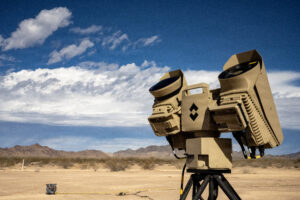
Counter-drone (CUAS) measures being employed by the Ukrainians include electronic jamming and nets at short ranges, and drone-vs-drone encounters. Artillery platforms are using fragmentation rounds, and as has already been explored elsewhere at GDA25, helicopters are also being used to down incoming uncrewed systems.
But a summary of drone operations from a single day helped to bring home the scale of the challenge being faced: 433 drones launched against Ukrainian forces, including about 250 loitering munitions; 349 of those defeated, and 84 systems hitting their targets.
It was summarised aptly in two phrases: “The air war is getting closer and closer to the ground,” and “Air power is like oxygen — when you have enough, you don’t think about it; when you don’t have enough, it’s all you can think about.”
Elsewhere, delegates heard about some of the activities of the Finnish Utti Jaeger special forces regiment, taking in its platforms and future plans. Recent developments include a newly acquired naval minelaying capability and a programme to increase the operational availability of its NH90 helicopters.
There was also reference made not only to its counter-hybrid warfare training exercise with the Finnish Police and the Border Guard’s Special Intervention Unit, but also to when these skills were called upon for real.
On Christmas Day 2024, the unit lent its assistance to authorities in an operation to board the Eagle S tanker, a suspected Russian shadow fleet vessel, in the wake of damage to the Estlink 2 undersea power cable linking Finland and Estonia.
As the speaker rather eloquently summarised: “It’s everything I told before, together.”
A presentation by Kharkiv National Air Force University (KNAFU) gave an overview of how it has been training Ukrainian aviators and described how it had needed to adapt its courses and approach in the wake of the Russian invasion in 2022.
Adoption of distance-learning platforms such as Moodle and exploiting Augmented Reality (AR) and Virtual Reality (VR) has helped students by maximising learning mobility and making use of all available spare time in the most challenging of day-to-day environments.
And with Kharkiv being so close to the front line, when war broke out, students and tutors from the university alike helped shore up air defences and formed two infantry battalions to carry the fight to the Russians.
There was a presentation from the Israeli Defence Force which provided a vivid, almost minute-by-minute account of the chaos of the October 7 attack and included audio footage of helicopters carrying troops towards the Gaza incursion coming under fire.
There were questions from the floor about how to detect enemy drones and differentiate them from friendly ones, and how to best manage coordination between air and ground forces.
Key takeaways were to anticipate that when conflict arrives, its nature will be unexpected, and you must train as you intend to fight. Prior to October 7, the IDF had not prepared for a mass attack, and the result was initial chaos. Conversely, low-altitude flight and emergency landing training which had been undertaken proved vital that day, and in the months that followed.
In the longer term, maintenance protocols to keep rotary-wing platforms available for extended periods were crucial, as was the ability to carry out repairs in the field, and are close interpersonal relationships to build trust; as the speaker put it, “People are everything.”
Going forward, the IDF considers that the role of helicopters is proven, both for the logistics of short-notice troop transport and medevac, as well as for combat missions and even counter-drone measures.
Training has been undertaken building on lessons from Ukraine, where troops have used shotguns to take out small drones, and helicopters have taken down UAS by flying above them and shooting them from above with machine guns at about 100m range, with about 50ft of vertical separation.
In the concluding plenary session, delegates heard about the constantly evolving electronic warfare battle in the Ukraine. They learned how navigational jamming is virtually a 24/7 constant, except when the enemy is attempting to employ its high-precision weapons.
Nowadays the range of frequencies being used to control UAS is so wide — from 150Mhz all the way up 2,700MHz — it makes countering them very challenging, with 12+ jamming systems potentially having to be mounted on a single vehicle, with their concomitant high power demands.
And there was a sobering warning about the dangers of using mobile phones in the battlespace even when not jammed, with groups of cellular signals presenting a viable target for artillery strikes.
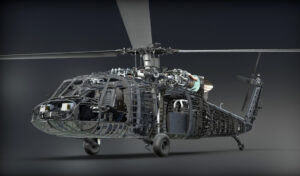
Industry sessions included a presentation from Sikorsky on its forthcoming platforms, including its Nomad family of UAS, and the prototype fully autonomous S-70UAS U-Hawk with a 10,000lb payload capacity potentially capable of deploying everything from fuel tanks and missiles to uncrewed ground vehicles (UGVs).
And the final talk was another IDF presentation on its recent experiences with UAS; the main message was that uncrewed systems have proved an invaluable force multiplier.
We heard how the Israeli Air Force used no fewer than ten separate uncrewed systems on a single mission, dubbed Operation Arnon, to free four hostages in the wake of the October 7 attacks.
More generally, the total number of flight hours flown by Israeli UAS has climbed from an average of 40,000 hours per year to more than 235,000 hours per annum across the last 24 months.
The main advantages afforded by UAS include long endurance, mission and payload versatility, and the ability to take on higher-risk missions without risking pilots.
And a flavour of how fast tasks can change was given by the following quote: “I was flying a mission over Lebanon when suddenly the controller comes on the radio and says, ‘Head straight to Damascus — the regime’s just fallen.’”
This presentation brought to a close three fabulous days of discussion and debate about all things rotary, aerial, and uncrewed, featuring 900 delegates, 35+ speakers, and 100-plus industry exhibitors from more than 85 countries worldwide.
We’d like to extend a warm vote of thanks to everyone who participated here this week in whatever capacity, and we look forward to welcoming you back again in 2026.