Image: Airbus
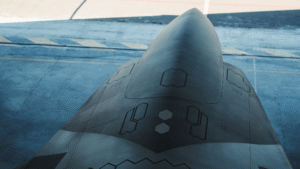
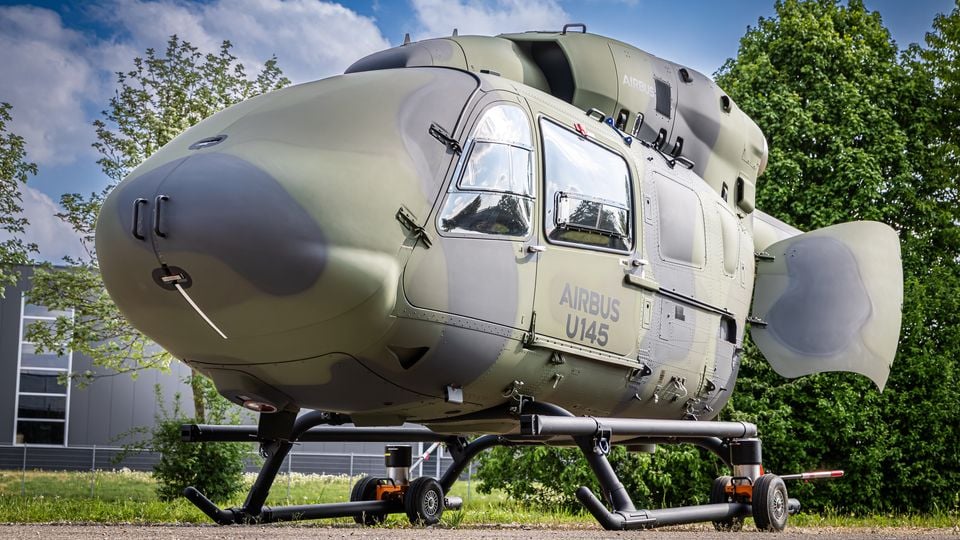
European aerospace manufacturer Airbus Helicopters has unveiled the U145, an autonomous uncrewed aerial system (UAS) derived from its proven H145 helicopter. As per a recent press statement, the company presented a full-scale mock-up of the platform this week, with a maiden flight with a safety pilot aboard planned before the end of 2026. Entry into service is targeted for the start of the next decade.
The U145 marks the second crewed helicopter Airbus has transitioned into an uncrewed platform, following the VSR700, derived from the Cabri G2. Unlike the crewed H145, the new variant carries no physical cockpit. A specialised sensor suite and an artificial intelligence (AI) system instead deliver full autonomous capability.
Matthieu Louvot, CEO of Airbus Helicopters, commented: “With the U145, we are offering our customers an autonomous, uncrewed version of our H145 helicopter, combining the proven airframe, power and useful load of the H145 with the autonomy of a UAS.” Louvot added: “To develop the U145 and its capabilities as a multi-mission UAS, we will be teaming up with leading autonomous mission partners to further expand the UAS ecosystem in Europe.”
With a maximum take-off weight (MTOW) of 3,800 kg, Airbus has designed the U145 as a mission-agnostic platform for civil and military applications. Primary focus falls on high-volume cargo supply. Structural adaptations include an integrated nose door, a foldable loading table, and a dedicated cargo floor. The modular architecture further supports roles including disaster management, firefighting, armed scouting, and surveillance. Airbus is also developing drone mothership functionality for air-launched effects in partnership with MBDA, alongside crewed-uncrewed teaming capabilities.
The broader H145 family provides a strong operational foundation for the programme. More than 1,800 variants serve across military, parapublic, and civil operations, collectively logging over 8.5 million flight hours. Twin Safran Arriel 2E engines with full authority digital engine control (FADEC) power the type. The H145 holds the lowest CO2 emissions and acoustic footprint among competitors in its class.
In the United States, Airbus U.S. Space & Defense is offering the US Marine Corps a dedicated domestic variant, developed alongside Shield AI, L3Harris, and Parry Lab. The MQ-72C designation covers a fully autonomous derivative of the UH-72B Lakota, tailored to Marine Corps-specific requirements.
The U145 debut reflects broader momentum in Airbus’s autonomous systems strategy. The company has also renamed its entire UAS range to align product naming across its helicopter and fixed-wing families. Full details on the updated portfolio are available via the Airbus website.