Image: Danish MoD
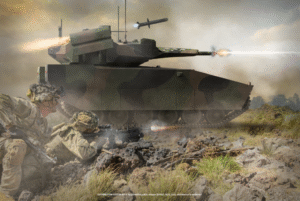
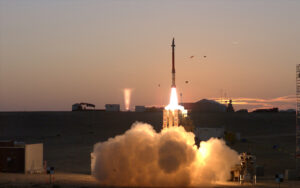
Denmark has successfully completed the first live firing of a SPIKE LR2 anti-tank missile integrated onto an Eagle 5 armoured patrol vehicle, marking a global first for the system combination.
The test, conducted on 6 November 2025 at the Danish Army’s Oksbøl training area, brought together the SPIKE LR2 missile, Kongsberg’s PROTECTOR RS4 remote weapon station, and the Eagle 5 platform. The first missile fired struck the centre of the target, confirming full system integration, according to the Danish Ministry of Defence’s Materiel and Procurement Agency (FMI).
The milestone places Denmark at the forefront of integrating long-range precision anti-armour weapons onto light reconnaissance vehicles, enhancing the Army’s ability to engage high-value targets at extended distances.
First integrated firing validates years of development
The live fire represented the first occasion globally where SPIKE LR2 was launched from a PROTECTOR RS4 weapon station mounted on an Eagle 5 vehicle. The missile was configured for a blast-fragmentation effect and performed exactly as intended.
The successful engagement validated the integration between missile, launcher, sensors, fire control system, and vehicle architecture. FMI confirmed that the result demonstrated both the missile’s precision and the stability of the overall weapon system.
Senior Sergeant Kim, who oversees SPIKE and weapon station integration within the Danish Artillery Regiment, described the firing as a major relief after years of preparation.
“It has been many years of work, and it was a huge relief to see the first missile hit exactly as planned,” he said, according to FMI. “Overall, the system works extremely well.”
SPIKE LR2 delivers extended reach and flexibility
SPIKE LR2 is a fifth-generation electro-optically guided anti-tank missile with a ground-launched range of up to 5.5 kilometres. It offers several capabilities relevant to modern land warfare, particularly for reconnaissance and light forces.
The missile can engage targets beyond direct line of sight and execute a programmable top-attack profile against armoured vehicles. Operators can select between a tandem HEAT warhead for heavy armour or a multipurpose blast-fragmentation charge.
A key feature is the “fire, observe and update” function, which allows operators to control the missile in flight. Gunners can refine the impact point or redirect the missile if the tactical situation changes.
In Danish service, SPIKE LR2 operates through both an integrated Command Launch Unit (iCLU) and a mounted Command Launch Unit (mCLU) on the weapon station. The iCLU manages remote operation, while the mCLU provides the physical interface on the turret.
PROTECTOR RS4 brings tank-level capabilities
The Danish Army’s stabilized weapon station, known as STAVS/P, is based on Kongsberg’s PROTECTOR RS4. The system features full 2+2-axis stabilization and supports heavy machine guns, grenade launchers, and anti-tank missiles.
For reconnaissance and infantry units, the RS4 allows rapid reconfiguration based on mission requirements. Crews can shift from direct fire support to long-range anti-armour roles without changing platforms.
According to Senior Sergeant Kim, integrated navigation and sensor systems mark a significant improvement over earlier weapon stations.
“The system has capabilities familiar from tanks, including GPS navigation and geo-referenced targets,” he said. “Targets remain fixed on the map regardless of vehicle orientation.”
The stabilized platform enables accurate fire while on the move and allows crews to operate entirely under armour.
Eagle 5 gains organic anti-tank capability
The Eagle 5 reconnaissance vehicle served as the test platform. Denmark has already selected SPIKE LR2 as its standard anti-tank missile, and integration on Eagle 5 significantly expands the vehicle’s combat role.
Once fielded, reconnaissance platoons across the Army’s three combat battalions will gain the ability to engage armoured and high-value targets independently at long range.
“This is a clear upgrade that provides additional combat power,” said Nicolai, head of weapons within FMI’s land division, according to FMI. “Units will receive a light, advanced system capable of defeating targets beyond five kilometres.”
Path to operational service
FMI stated that the next phase includes final integration work, correction of minor issues, delivery of remaining weapon stations, and expanded crew training. The system will then enter service gradually as part of Denmark’s broader modernisation of land combat and support vehicles.
The successful firing confirms Denmark’s progress in enhancing reconnaissance lethality while maintaining mobility and protection, according to the Ministry of Defence’s Materiel and Procurement Agency.
Source: Danish MoD