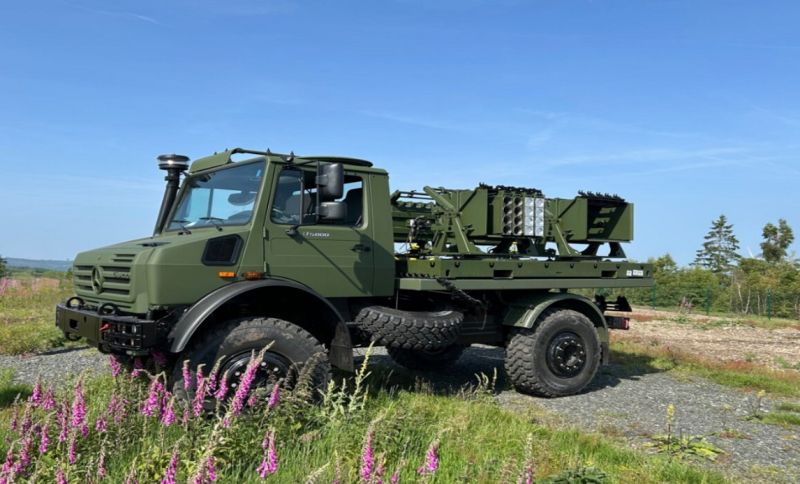
Image: Danish Ministry of Defence Materiel and Procurement Board
Denmark has taken a significant step in building out its planned heavy brigade with the acquisition of its first dedicated mine-thrower systems, according to the Danish Defence Acquisition and Logistics Organization (FMI). The agency has signed a contract with German manufacturer Dynamit Nobel Defence GmbH for eight systems, marking the introduction of a new battlefield capability for the Danish Army.
A New Capability for Danish Ground Forces
“This contract brings a completely new capability into the Danish Army,” said Colonel Thomas Øgendahl Knudsen, Head of FMI’s Land Division, in a statement carried by FMI. He noted that the mine-thrower systems will play a key role in the brigade’s defensive operations, enabling armoured units to quickly deploy minefields to block, slow, or channel enemy manoeuvres.
The acquisition aligns with Denmark’s broader efforts to strengthen its land forces following commitments made within NATO to field a combat-ready heavy brigade. Armoured mobility and area-denial systems, including modern mine-laying tools, have been identified as essential elements for meeting alliance requirements and contributing to deterrence along NATO’s eastern flank.
System Design and Flexibility
The mine-thrower units purchased by Denmark are based on a compact design mounted on a standard 10-foot container frame. This configuration allows the system to be installed on a small military truck or integrated onto unmanned ground vehicles, offering flexibility for both manned and remote-operated deployment.
Mine-thrower systems are engineered to rapidly place rows of anti-tank mines across wide areas, enabling ground forces to erect defensive barriers at short notice. Such capabilities are increasingly valued in modern European defence planning, where mobility, speed, and the ability to shape terrain are central to countering potential mechanised threats.
Training and Delivery Timeline
The first Danish-configured systems are scheduled for delivery in 2026. Ahead of their arrival, FMI will train instructors and mechanics to ensure the Army can operate and maintain the new equipment from day one. According to FMI, the contract includes both training magazines and live-mine magazines to support the full spectrum of operational and instructional needs.
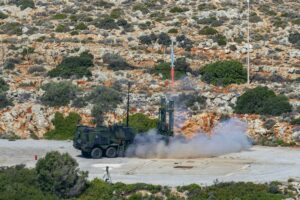
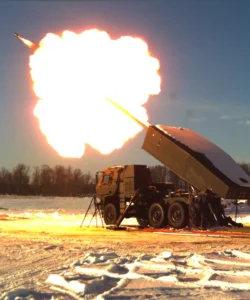
An image released with the announcement depicts a similar system installed on a vehicle, although FMI clarified that the photo does not represent the final Danish configuration. The Danish Army’s version will be mounted either on a small truck platform or on an unmanned vehicle, depending on operational requirements.
Broader Defence Context
Denmark’s investment in mine-laying capabilities comes amid a wider push to modernise its land warfare systems, including new armoured vehicles, artillery enhancements, and expanded engineering capabilities. NATO members have placed renewed emphasis on fixed and mobile barrier-laying systems—capabilities that proved critical in recent conflicts and are considered vital for delaying or stopping armoured thrusts.
By integrating these mine-thrower systems, Denmark aims to improve the survivability and operational flexibility of its heavy brigade while contributing to NATO’s collective defence posture.
Source: Danish Ministry of Defence Materiel and Procurement Board