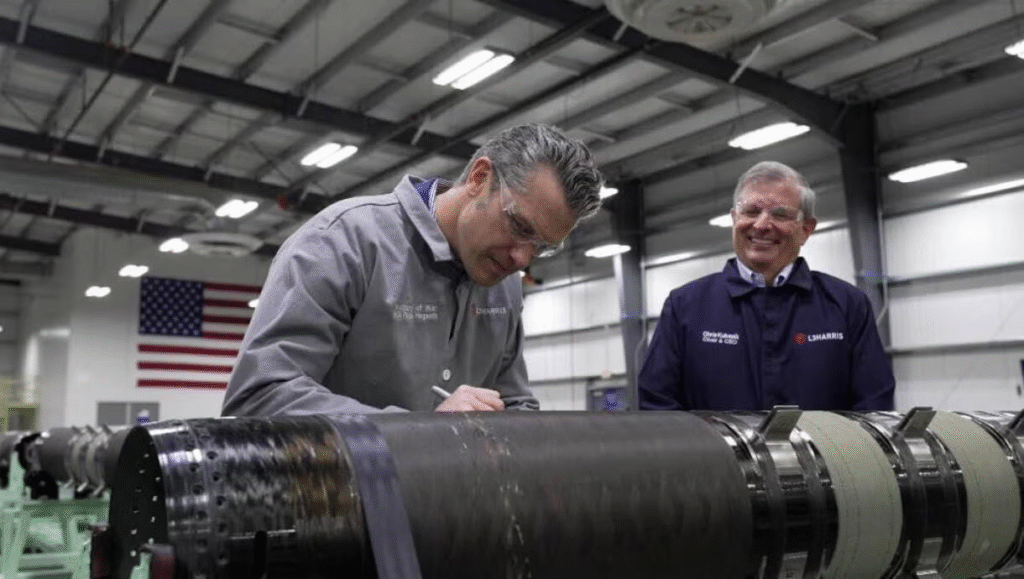
Image: Secretary of War Pete Hegseth visited L3Harris’ PAC-3 propulsion facility in Camden, Arkansas, as part of his “Arsenal of Freedom” tour in February 2026. ©L3 Harris
The Department of War has signed two seven-year framework agreements with L3Harris to expand production of key propulsion components for the PAC-3 MSE and THAAD missile defence systems. Lockheed Martin also joined the THAAD agreement.
Scaling Up Interceptor Manufacturing
The first deal covers the Patriot Advanced Capability-3 Missile Segment Enhancement interceptor. L3Harris will accelerate production of its two-pulse solid rocket motor, Attitude Control Motors, and Lethality Enhancer. These components give the PAC-3 MSE the speed, range, and precision it needs to intercept ballistic missiles, cruise missiles, and enemy aircraft.
Expanding THAAD Propulsion Capacity
The second agreement targets the Terminal High Altitude Area Defense system. It expands manufacturing of the solid rocket boost motor that launches the interceptor, alongside the Liquid Divert and Attitude Control System. This system provides the in-flight manoeuvrability THAAD needs to neutralise ballistic missile threats inside and outside the atmosphere.
Michael P. Duffey, Under Secretary of War for Acquisition and Sustainment, commented: “Rebuilding the Arsenal of Freedom requires moving with speed and precision to scale the production of critical munitions.” He added that the agreements send “clear demand signals to the entire supply chain.”
Part of a Wider Industrial Push
The deals follow earlier PAC-3 MSE agreements with Lockheed Martin, Boeing, and Honeywell. They stem from the Department’s Acquisition Transformation Strategy, which cuts bureaucratic delays and enables direct engagement with suppliers across the industrial base. The strategy aims to place US defence acquisition on a wartime footing, giving industry stable long-term demand and strengthening America’s manufacturing edge over potential adversaries.
Read more on the U.S. Department of War’s website