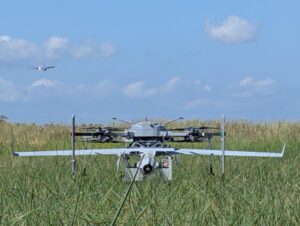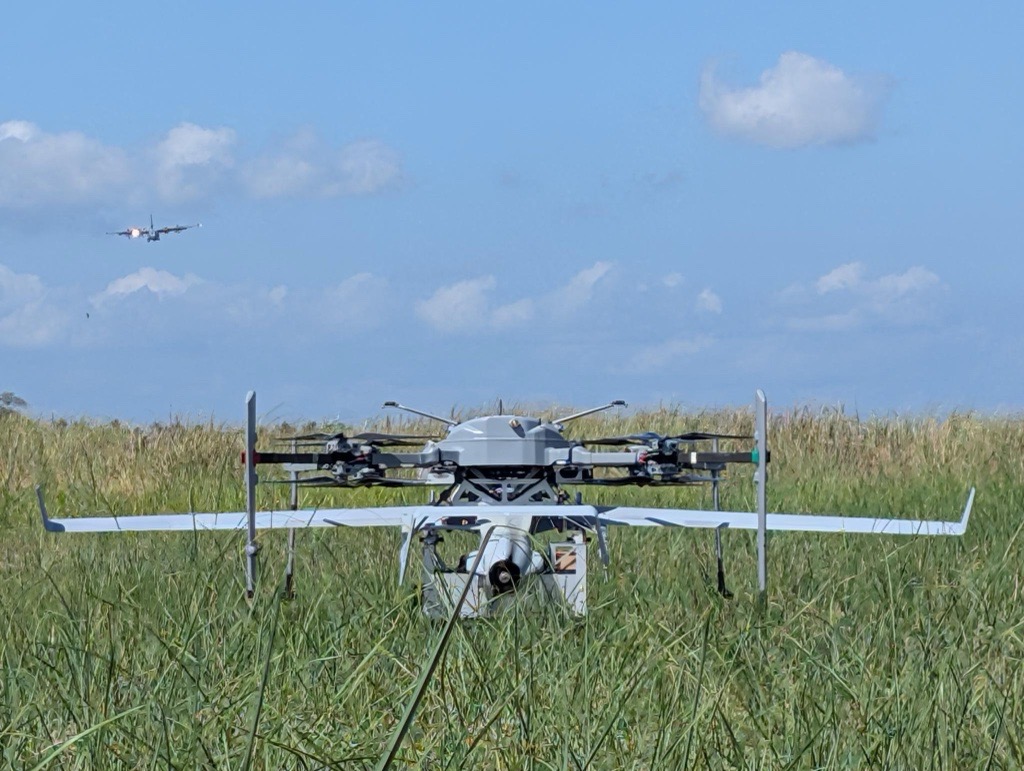
Image: Integrator VTOL with FLARES ready to launch from FARP location — Insitu
Insitu’s Integrator VTOL unmanned aerial system has completed a series of demanding demonstrations at Exercise Balikatan 2026, validating long-range surveillance, multi-sensor integration, and AI-enabled battle management in some of the most challenging operational conditions the Indo-Pacific can offer.
Conducted across the Philippines, Balikatan 2026 brought together US and Filipino forces for large-scale combined arms training. Insitu, a Boeing subsidiary, used the exercise to operate its Integrator VTOL from austere forward sites in heat indices reaching 107°F and density altitudes exceeding 12,000 feet.
Record Endurance and Extended-Range ISR
The platform’s standout achievement was a 22.4-hour sortie flown at density altitudes between 6,500 and 9,000 feet, returning with 1.5 hours of reserve fuel. At ranges out to 200 nautical miles, it sustained over six hours on station during Maritime Domain Awareness and ISR missions.
The system flew in a multi-intelligence configuration, pairing the IMSAR NSP-5 Synthetic Aperture Radar with a Hood Technologies multi-spectral EOIR6 gimbal in a cross-cueing arrangement. Arkeus’ Warden passive Hyper-Spectral Optical Radar detected vessels at 35 nautical miles through marine haze, cross-cued with an onboard ACO9 narrow field-of-view gimbal.
The results carry real operational weight. The Indo-Pacific’s vast maritime distances and increasingly contested airspace put a premium on long-endurance, multi-sensor platforms that can operate from dispersed, low-signature positions.
Expeditionary Agility for EABO
Insitu also demonstrated the platform’s fit for US Marine Corps Expeditionary Advanced Base Operations (EABO), the force posture concept built around distributed, island-hopping warfare against a near-peer adversary.
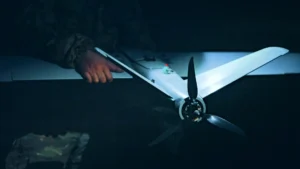
Using the small-packout FLARES VTOL ground system, operators completed a full landing and relaunch cycle from a covert austere position in 38 minutes. A backpack-portable, battery-powered ground control station was carried on foot into a Forward Arming and Refueling Position (FARP). That compact logistics footprint addresses a requirement conventional Group 4-5 platforms have long struggled to meet.
AI Integration and Airspace Management
Integrator’s sensor data fed in real time into an AI-enabled battle management system, pushing actionable intelligence across a networked common operating picture. Boeing’s PLEO SATCOM and airspace management software supported safe operation throughout in uncontrolled airspace.
Insitu CEO Diane Rose said the exercise results spoke for themselves. “We brought our systems into some of the most challenging conditions, and they performed as designed,” she said, according to Insitu. “Integrator truly delivers Group 4-5 ISR and targeting capabilities at a fraction of the cost.”
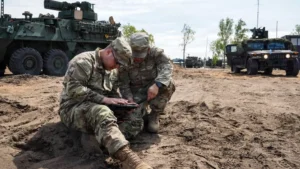
Exercise evaluators described Insitu’s field team, operators with decades of combined combat experience, as “obvious professionals.”
Strategic Context
Insitu has fielded more than 3,500 UAS across 35 allied and partner nations from its headquarters in Bingen, Washington. The Integrator VTOL offers up to 27.5 hours of endurance and 50 pounds of payload capacity across ten mounting points, with over 1,000 potential configurations covering electronic warfare, communications relay, targeting, and kinetic options.
Balikatan 2026 arrives against a backdrop of sustained US investment in Indo-Pacific posture and growing emphasis on distributed maritime operations. Proving that a low-cost, high-endurance uncrewed platform can operate effectively from a rucksack-sized ground station in theatre conditions makes a pointed argument for this class of system.
Read more on Insitu’s website