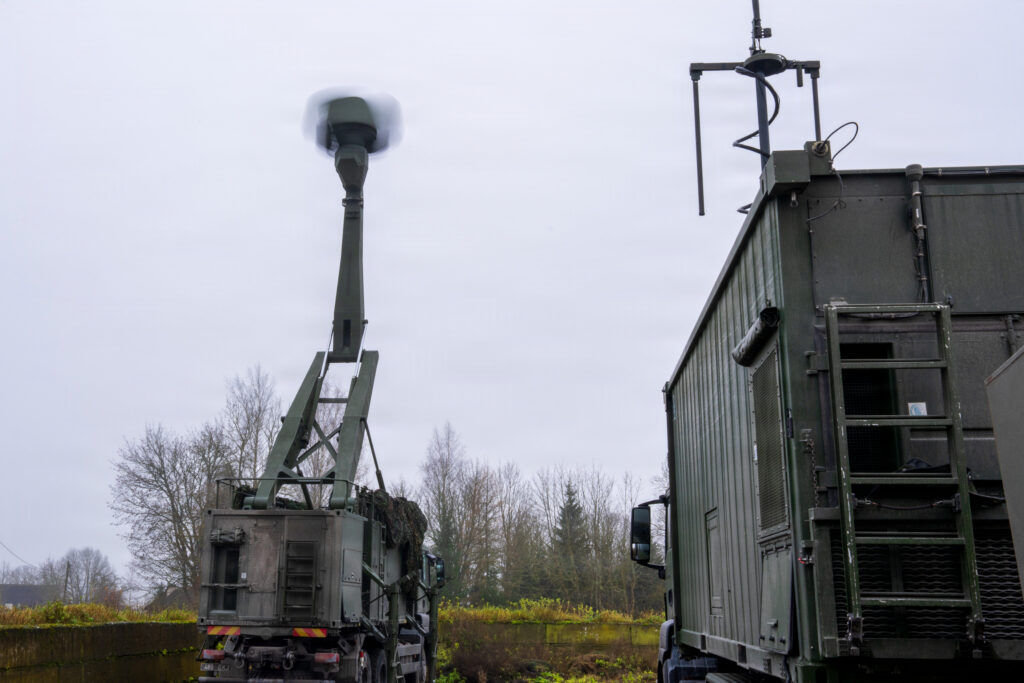
The British Army has deployed its first passive counter-drone detection system at Warminster garrison, delivering a UK first for base protection in under six months, according to UK Defence Innovation (UKDI).
Project Halo Shield, led by the Army’s Experimentation and Trials Group (ETG) and funded by UKDI, moved from concept to operational capability at pace. In its first 17 days, the system recorded 29 drone position alerts, detecting activity up to 5km away. None posed a threat to the base.
Two UK suppliers delivered the layered solution. Dedrone, now part of Axon, provided radio frequency (RF) sensors and command-and-control software that identify both a drone and its operator in real time. Three RF sensors triangulate a drone’s position, while a fourth handles identification. Nick McRobb, Dedrone’s UK defence lead, commented: “We moved quickly. We were installed and operational within a few months of our site recce.”
Quell, a British company, added optical detection through its SkySpyke system, offering full hemispheric sky coverage and AI-assisted threat identification. The company previously used UKDI funding to develop its Deep Truth software platform and refine SkySpyke’s hardware. Bobby Hamilton, Quell’s Chief Operating Officer, added: “The drone threat is evolving, with a migration away from traditional RF-emitting capabilities. That’s where we can really add value.”
Both suppliers had already tested their technology against live drone activity through earlier ETG exercises, Project Vanaheim and Project Flytrap, which helped speed the deployment.
ETG says the results now inform plans to expand passive detection across the wider defence estate, potentially adding radar and acoustic sensors to build a fully layered architecture. Col James Howard of ETG commented that the project strengthens force protection while advancing the Army’s counter-drone capabilities.
Learn more on the UK MoD website