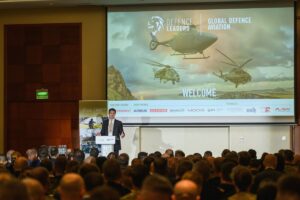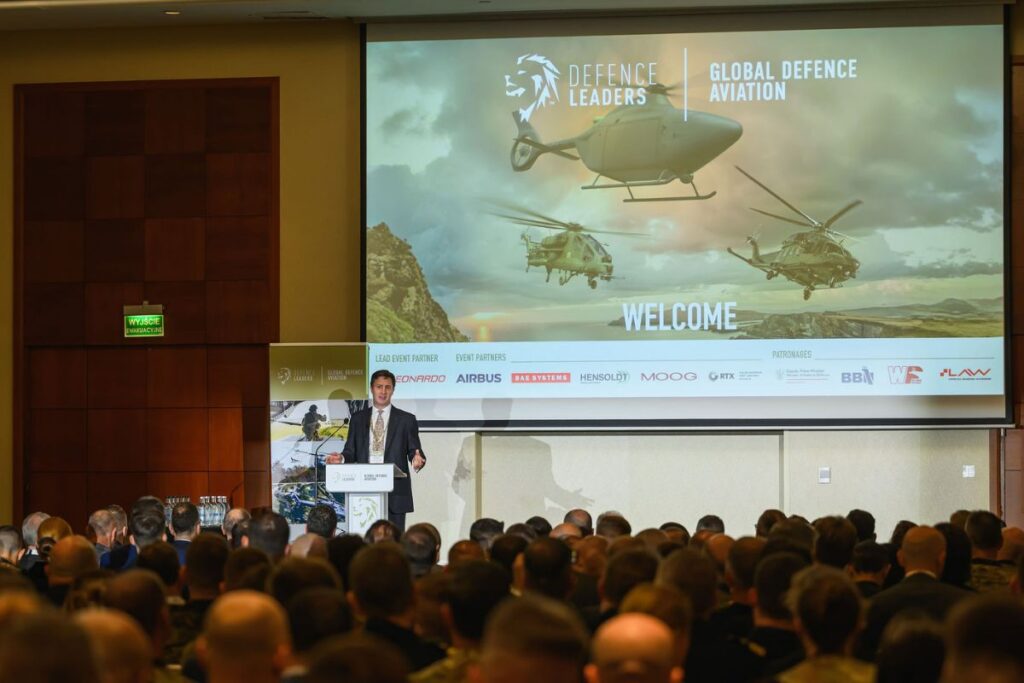
Global Defence Aviation 2026 (GDA 2026) has come to an end — and this year’s conference has hit the heights once again!
It’s been our biggest and best aviation show yet, with more than 850 delegates through the doors over the last three days representing 59 countries, 125+ industry exhibitors, and about 70 expert speakers.
Day Three sustained the momentum of the last two, the morning offering a choice of topics in two separate theatres before bringing everyone together for a final plenary session. Predictably, Ukrainian briefings drew the largest crowds, but there were plenty of other insightful discussions too.
One valuable briefing took in Bosnia-Hercegovina’s procurement support to its fleet modernisation programme.
The country is transitioning from Mi-17s to AW119s; the speaker noted, though, that this would not completely restore previous capabilities and a separate medium transport helicopter programme would be needed to achieve this.
They characterised Bosnia as “a complex country with a complex decision-making process,” and pointedly noted: “Buying a helicopter is not the same as establishing a capability… We must purchase a complete aviation capability, and not just an aircraft.”
In 2006 the country acquired a unified air force for the first time, and inherited a wide mix of legacy platforms. What created its current capability gap? The fleet continued to age, and replacement was slower.
Throughout the presentation there were recurring themes: the difficulty in replacing experienced pilots and instructors, and the need for realistic budgets that also factor in inspection, repairs, spare parts etc.
The transition is challenging, because Eastern and Western technologies take a completely different approach. They said: “The question is not whether legacy platforms are useful, but can we continue to sustain them safely and affordably?”
They also noted: “The war in Ukraine did not create our problems, but it makes them worse.” Impacts include making it harder to source spares for legacy platforms, driving up the prices and delivery times for those parts.
The conclusion: “A fleet dependent on politically exposed airframes must be transitioned before it collapses.”
Another briefing focused on the Royal Canadian Air Force (RCAF), set against the backdrop of significant modernisation across all branches of Canada’s armed forces, not just the air force.
The RCAF is switching from a regionally organised tactical aviation force to a functionally aligned model; its main missions are supporting air mobility, combat reconnaissance, and firepower.
Upcoming programmes include (in chronological rather than numerical order):
- Phase I: Recapitalisation of fleet for special forces aviation, which uses Griffons at present;
- Phase III: Replacement of Griffon with a new medium-lift helicopter in the early 2030s, with capability wishlist and starting to drawing up a shortlist of potential platforms likely to begin in spring 2027; and
- Phase II: Acquisition of a new attack reconnaissance platform.
Another as-yet-unfunded programme is a potential expansion of the RCAF Chinook fleet with perhaps an additional six to eight airframes. It is also looking at integrating new uncrewed aerial systems (UAS) of varying sizes and capabilities.
Future challenges include operating in multiple theatres simultaneously: both in terms of continental defence in North America, and expeditionary deployments in Europe, not least in Latvia where Canada has ongoing NATO commitments. In the spring the RCAF will also contribute Chinooks to Exercise Steadfast Defender 2027.
Other challenges include balancing interoperability requirements between NATO on one hand and NORAD on the other, and overcoming the hurdles that continue to be posed by Canada’s geography and climate.
These include improving the geographical spread of Canadian platforms, which are currently concentrated in the south and east, to reduce deployment times to the country’s more farflung regions.
The challenges of climate are not to be underestimated either: last winter, air crews had to meet the challenge of conducting maintenance on Chinook airframes in temperatures which consistently hit -40C!
Later on, it was standing room only for presentations from the Ukrainian Army Aviation Command, offering their perspective on lessons learned on platform and mission survivability.
One speaker talked specifically about platform reliability and necessary future capabilities to ensure future effectiveness.
They noted: “Victory in the air starts with proper maintenance on the ground.”
Key metrics in assessing platform effectiveness included mission availability in real-time conditions, and mean time to restore readiness.
Protection against environmental influences such as dust to vital machine elements such as helicopter engines was an integral part of operational reliability, especially when crews are habitually flying very low-level sorties as is commonplace in Ukraine now to reduce platform vulnerability to attacks.
And going forward, they said, given the prevalence of electronic warfare, platforms with sole reliance on GNSS for navigation would be “wholly unacceptable.”
In a second presentation the audience saw video footage of a variety of everyday combat operations in Ukraine, including both shooting down UAS and prosecuting ground targets.
The speaker said: “The idea behind this is simple: the key question is will the helicopter survive? Now we have to ask a wider question: will the mission survive?”
An overriding trend for helicopter operations is a switch from threats mainly from the ground, to threats from every domain. Ukraine already lives this reality daily: “Every day the battlefield is more dangerous for the helicopter.”
The speaker talked about having to cope with layered Russian air defence systems: these are countered via flying at very low altitude and using terrain-masking tactics, spending only very short periods of time over targets, and engaging at stand-off ranges.
They noted: “These tactics still work, but on their own they are not enough.”
New generations of jet-powered Geran drones are getting more dangerous and harder to engage, we were told. Interceptor drones are being used by both sides, and the biggest threat to helicopter platforms are fibre-optic drones: for enemy interceptors, a helicopter is “a big, slow, hot target.”
Fibre-optic and ambush drones are immune to electronic warfare, can loiter for hours on the ground, take off suddenly, and typically strike during breakaway turns after an attack.
The audience was shown one video where a Ukrainian helicopter crew survived a fibre-optic drone attack because the crew had spotted it with their own eyes at the last second and the platform was able to dodge the drone.
But the speaker warned: “A sensor should have warned them much earlier… We cannot build survivability on luck.”
Breaking these ambushes depends on good coordination with ground units, which can help clear the area of threats; mixing up strike tactics to be less predictable; ensuring crews stay hyper-alert on lookout; and deconfliction of an increasingly crowded airspace.
The speaker remarked: “Helicopters should be clearly marked as friendly, otherwise the threat may come from our own side… sadly this has already happened on some occasions.”
Platform survivability considerations also extend to when airframes are on the ground: this requires dispersal of units, moving often, and thermal signature camouflage.
Classic sensors cannot see fibre-optic threats: there’s a need for next-generation platforms to feature 360-degree electro-optical sensors to spot these kinds of drone attacks. And going forward, the focus needs to be on active protection, flexible tactics and fast adaptation.
MUM-T opportunities are limited with ageing and legacy airframes, some of which date from the 1960s; there are benefits to using drones as forward ISR and standoff-range strike assets, but the price is increased cognitive load for pilots and crew.
In future, they suggested, AI has a role in providing target detection, information filtering and terminal guidance. But combatting a cheap, massive threat needs affordable, mass-produced answers.
Thanking the audience for their continued support, the speaker concluded: “Ukraine is ready to share its experience: we invite you to work with us.”
These presentations brought to a close three fabulous days of discussion and debate about all things rotary, aerial, and uncrewed. We’d like to extend a warm vote of thanks to everyone who participated here this week in whatever capacity, and we look forward to welcoming you back again in 2027.