Image: Anduril
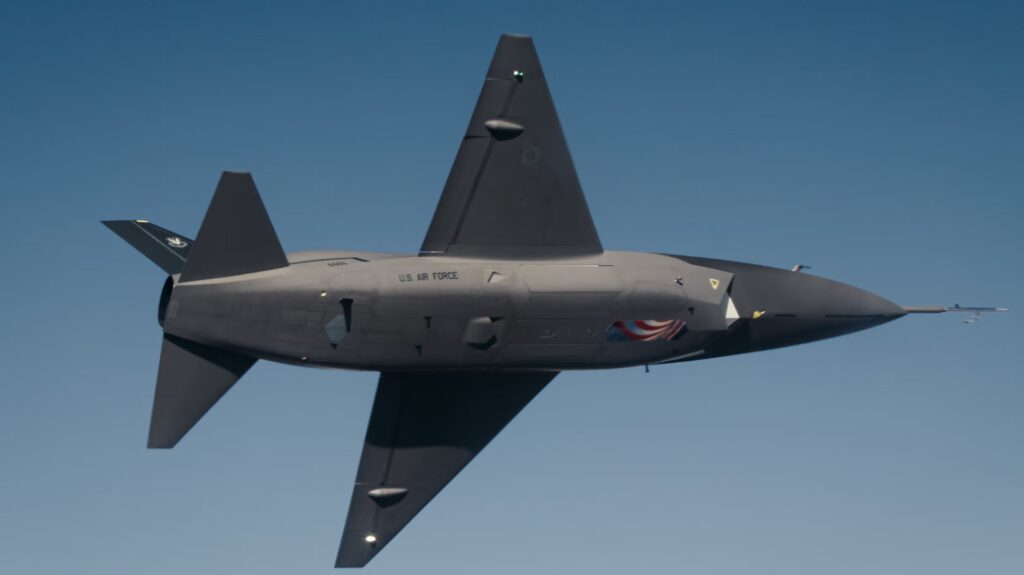
The U.S. Air Force’s Collaborative Combat Aircraft programme has reached a new benchmark, with Anduril’s YFQ-44A unmanned fighter successfully operating two separate mission autonomy software suites in a single flight.
The aircraft flew with both Shield AI’s Hivemind platform and Anduril’s own Lattice for Mission Autonomy stack — sequentially, on the same sortie. The test validated a core principle of the CCA programme: that open, modular architectures can support a competitive ecosystem of autonomy software providers, according to Anduril.
A Rapid Development Timeline
Anduril received its contract to produce CCA prototypes in April 2024. Just 556 days later, the YFQ-44A completed its first semi-autonomous flight — the first such flight by a fighter-class CCA in aviation history. Multiple aircraft now fly regularly, and the programme’s pace shows no signs of slowing.
During the latest test flight, the YFQ-44A took off and flew autonomously to a designated point. Engineers then activated Hivemind to complete a series of test cards. Once complete, the aircraft seamlessly transitioned to Lattice for Mission Autonomy, running the same test points before landing safely.
The ability to switch between independently developed software stacks mid-flight represents a significant technical achievement. It was made possible by early implementation of the Autonomy Government Reference Architecture, known as A-GRA — a universal standard the U.S. Air Force defined to drive software interoperability and competition.
Shield AI’s Hivemind Performs as Expected
Anduril and Shield AI teams worked closely for several months ahead of the flight. Engineers from both companies integrated Hivemind directly with the YFQ-44A’s flight control software. They ran extensive software-in-the-loop simulations and hardware-in-the-loop test events to validate performance before the aircraft ever left the ground.
During the flight, Hivemind guided the YFQ-44A through a complex series of test points representative of real-world mission profiles. The software performed as expected. Anduril stated it plans to accelerate collaboration with Shield AI in the coming months.
Anduril Builds Lattice from the Ground Up
In parallel, Anduril invested its own capital to develop Lattice for Mission Autonomy. The company describes its aim as building the best mission autonomy product for air dominance — without qualification. This latest flight marks the software’s first major airborne milestone, though Anduril acknowledges significant development work remains ahead.
The dual-stack flight directly demonstrates the YFQ-44A’s modular design philosophy. The aircraft uses a straightforward airframe with external stores and open hardware and software architectures. This allows operators to configure it with different mission systems, payloads, and software suites depending on the task.
Implications for the CCA Programme
The CCA programme sits at the centre of the U.S. Air Force’s strategy to field large numbers of affordable, autonomous aircraft operating alongside crewed fighters. Mass, affordability, and flexibility are central to that vision.
Proving that multiple autonomy stacks can operate on a single airframe validates the acquisition strategy. The Air Force gains leverage — it can draw on competing software providers as mission needs evolve, rather than locking into a single vendor.
With this milestone cleared, the programme moves toward its next phase. Upcoming testing will cover detailed mission concepts of operations, weapons integration, multi-ship flights, and integration with crewed fighter aircraft.
The YFQ-44A continues to set the pace for a new era of military aviation.
Source: Anduril Press Release