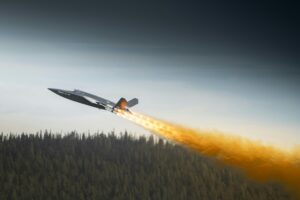
Image: Northrop Grumman
Northrop Grumman has taken the wraps off Project Talon, a new autonomous combat aircraft designed to operate alongside crewed fighters, marking the defence contractor’s latest move to accelerate the U.S. military’s shift toward collaborative, AI-enabled airpower. The aircraft was formally announced at the company’s Mojave facility on 4 December, according to Northrop Grumman.
Project Talon is positioned as an “autonomous teammate” that can fly in formation with traditional fighter aircraft, conduct independent tasks, and expand the reach and survivability of crewed platforms. The system is intended to support a range of missions—from strike support to sensing—reflecting a broader Pentagon effort to field affordable, highly adaptable uncrewed aircraft at scale.
A Focus on Speed and Modular Design
Northrop Grumman says the aircraft was conceived, built, and is on track to fly in under 24 months, an aggressive development timeline enabled by modular manufacturing techniques. The company describes this approach as “disruptive,” emphasising simplicity and rapid iteration to meet emerging requirements.
At the core of the programme is Beacon, Northrop Grumman’s autonomous testbed environment introduced earlier in 2025. Beacon allows avionics and mission software to be evaluated in operationally realistic scenarios before flight testing, accelerating integration and reducing risk. According to the company, Beacon played a central role in validating Project Talon’s autonomous behaviours ahead of its initial flight.
Designed for Collaborative Combat
Project Talon is intended to strengthen the concept of manned–unmanned teaming—a priority for the U.S. Air Force as it develops next-generation air dominance capabilities. By acting as a force multiplier, the aircraft is expected to increase mission flexibility, deliver additional sensors or firepower, and take on high-risk tasks that would otherwise endanger pilots.
Northrop Grumman says Talon builds on more than 500,000 autonomous flight-test hours accumulated across seven decades, covering air, land, sea, and space systems. That legacy includes several of the U.S. military’s most enduring uncrewed platforms. The company argues that experience has informed Talon’s design philosophy, focusing on adaptability, reliability, and operation in contested environments.
For U.S. and international customers, the aircraft is pitched as a tool for boosting airpower in increasingly dynamic threat conditions. Several nations, from Australia to Japan and European partners, have explored similar “loyal wingman” concepts, underscoring global interest in autonomous combat systems.
Part of a Broader Autonomy Push
The unveiling follows Northrop Grumman’s announcement of Beacon earlier this year and comes as major U.S. defence primes compete to supply autonomous aircraft for the Department of Defense’s Collaborative Combat Aircraft (CCA) programme. While the company did not specify whether Talon is being positioned for CCA, the platform aligns closely with the Pentagon’s stated goals: rapid production, modular payloads, and affordable mass.
Northrop Grumman emphasised that Talon’s development is part of a deliberate strategy to accelerate autonomy with “speed and decisive action,” according to the announcement. As militaries worldwide prepare for highly contested air operations, such systems are expected to play a central role in future force structures.
The company plans to conduct Talon’s first flight following completion of ongoing ground and autonomy testing.
Source: Northrop Grumman Press Release