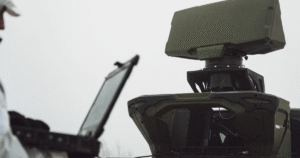
Image: Kongsberg
Norway’s Kongsberg Defence & Aerospace has secured a NOK 16 billion ($1.4 billion) contract to supply Poland with advanced counter-drone systems, marking one of Europe’s largest deals in anti-unmanned aerial vehicle technology.
The Norwegian defence firm and its consortium partner, Polish state-owned Polska Grupa Zbrojeniowa (PGZ), signed the agreement with Poland’s Armaments Agency to deliver 18 Counter-Unmanned Aerial Systems (CUAS) batteries under the SAN CUAS programme, according to a company statement.
Comprehensive Multi-Layered Defence
The contract addresses Poland’s urgent need to counter evolving threats from unmanned aerial platforms. Warsaw has prioritised drone defence following lessons from the Ukraine conflict, where small UAVs have transformed modern warfare.
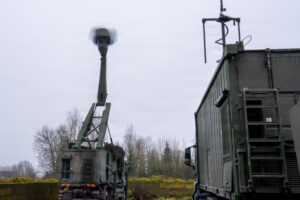
Each battery will deploy multiple weapon types. The systems integrate 35mm, 30mm, and 12.7mm guns alongside missiles and interceptor drones. This layered approach provides flexible response options against diverse aerial threats.
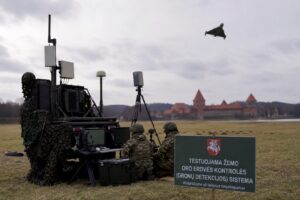
Advanced Protection Systems (APS), a PGZ subcontractor, will supply a tailored command and control architecture. The system will link sensors and effectors while integrating fully with Poland’s national air defence network.
Strategic Industrial Partnership
Eirik Lie, President of Kongsberg Defence & Aerospace, emphasised the deal’s broader significance. “This programme confirms Poland’s position as a regional hub for counter-drone innovation,” Lie stated. He added the contract strengthens Kongsberg’s standing as a leading European anti-drone solutions provider.
The collaboration represents NATO-aligned industrial cooperation designed to bolster European security capabilities. Kongsberg plans to expand its Polish manufacturing capacity, enabling higher production volumes of defence systems and technologies.
Poland’s emergence as a counter-drone hub reflects its strategic location on NATO’s eastern flank. The country has substantially increased defence spending amid regional security concerns.
Proven Technology Platform
The SAN CUAS programme builds on Kongsberg’s PROTECTOR family of weapon systems. Central to the design are the Medium Caliber Turret (MCT30) and Remote Weapon Station platforms.
The MCT30 entered full-rate production with characteristics suited to counter-drone operations: unmanned operation, lightweight construction, and fully digitalised systems. For SAN CUAS, the Remote Weapon Station will primarily deploy 70mm guided missiles.
PROTECTOR’s modular architecture allows integration of various CUAS effectors. Kongsberg will collaborate with APS and PGZ to develop flexible sensor and effector platforms. These enable distributed operations across vehicles and subsystems.
All PROTECTOR remote weapon systems possess counter-drone capabilities. Kongsberg has delivered over 20,000 PROTECTOR systems to more than 30 countries, providing an established operational track record.
Regional Defence Implications
The contract underscores Poland’s aggressive defence modernisation programme. Warsaw has committed to spending 4% of GDP on defence, the highest proportion among NATO members.
Counter-drone technology has become critical as adversaries increasingly employ low-cost UAVs for reconnaissance, targeting, and direct attacks. Poland’s investment reflects recognition that traditional air defence systems require supplementation with specialised anti-drone capabilities.
The programme’s scale positions Poland as a potential exporter of counter-drone expertise within Central Europe. Local production capacity through the Kongsberg-PGZ partnership may create opportunities for regional technology transfer.
Deliveries under the contract will begin according to a timeline not publicly disclosed. The agreement strengthens defence ties between Norway and Poland while advancing European strategic autonomy in critical defence technologies.
Source: Kongsberg Press Release