Image: Social media
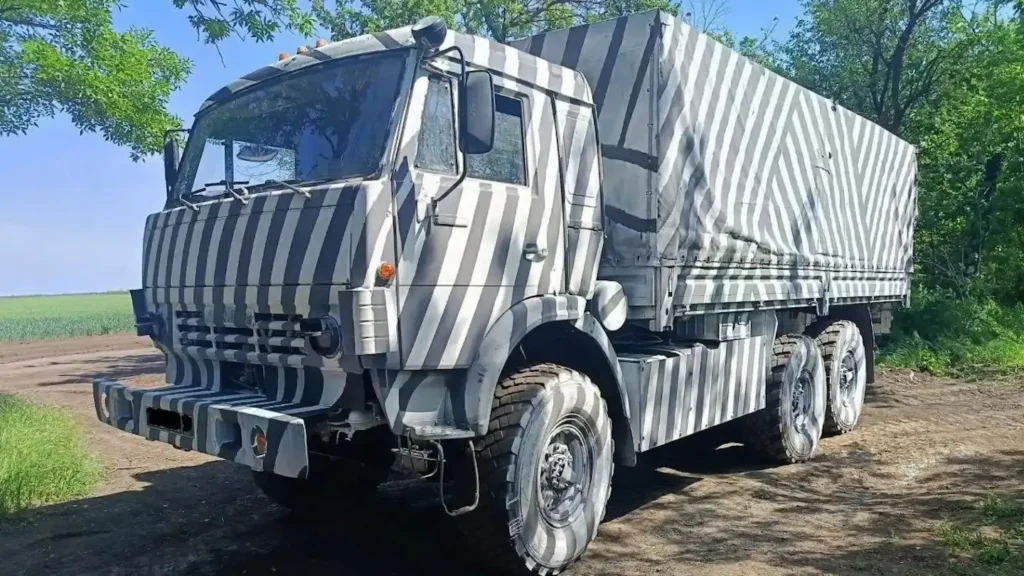
Russian forces have begun applying striking black-and-white geometric patterns to military vehicles in a bid to confuse Ukraine’s AI-guided autonomous drones, reviving a counter-measure first developed during the First World War.
Images of Russian military trucks bearing bold zigzag stripes have spread widely across social media. The distinctive paint scheme, known as “dazzle camouflage” or the zebra pattern, does not conceal vehicles from the human eye. Instead, it targets the machine-vision algorithms powering Ukraine’s increasingly sophisticated drone arsenal.
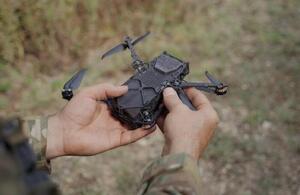
Ukraine has deployed a growing array of autonomous unmanned aerial systems (UAS) capable of independently identifying and engaging targets. These platforms rely on artificial intelligence to distinguish vehicles, calculate trajectories, and initiate strikes with minimal human input. Russia’s dazzle camouflage aims to disrupt this targeting process by feeding drone visual systems contradictory or ambiguous data.
The technique dates to 1917, when a British artist working with the Royal Navy developed it to protect Allied shipping from German submarine attacks. The goal was never concealment but deception, making it difficult for observers to accurately judge a vessel’s direction, speed, and size through bold contrasting geometric shapes.
Russia is now betting the same logic applies to modern computer vision systems. AI-driven targeting relies on pattern recognition and object classification, processes that sharp, irregular contrasts can potentially disrupt.
The development reflects the rapidly evolving drone warfare shaping the Ukraine conflict. Ukrainian forces have used UAS at scale to strike Russian armour and logistics throughout the war, forcing Moscow to explore unconventional low-cost countermeasures alongside electronic jamming and vehicle hardening. Whether a concept designed to fool submarine crews over a century ago can now defeat machine-learning targeting algorithms remains an open question.
Read more on the war zone’s website